eMTB tire casings: EXO, Super Trail, DD, DH and when to pay more
eMTB tire casings: EXO, Super Trail, DD, DH and when to pay more
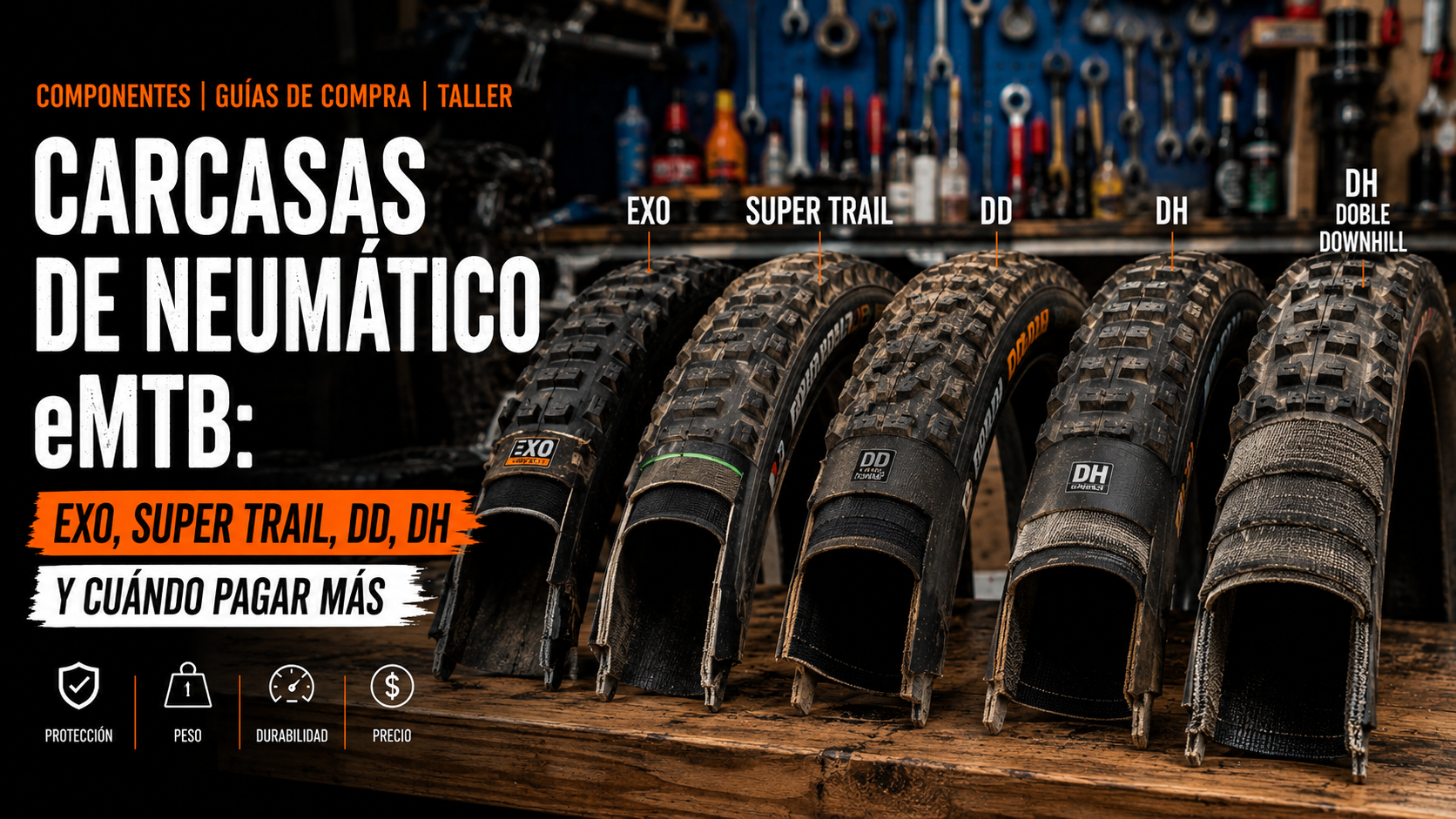
On an eMTB, tyre casing is almost as important as tread. It determines more than weight: it affects lateral support, rim-strike protection, cut resistance, cornering stability and how low you can run your pressures without damaging the rim.
Light, fast and sufficient for gentle trails or riders with a smooth technique.
A mid-range option for demanding trail riding and lightweight e-bikes.
DoubleDown: Enduro, e-bike and aggressive use.
Maximum protection, more weight and more support.
What is a tyre casing?
The casing is the tyre's internal structure: the fabrics, plies, sidewall reinforcements and inserts that give it shape and strength. Tread determines grip and braking, but the casing determines how well the tyre withstands rocks, roots, drops, hard cornering loads and landings.
Advertisement / sponsored link
This matters more on an eMTB because the bike is heavier, descends faster and usually places more load on the rear wheel. The motor also delivers plenty of torque on technical climbs, putting extra strain on the rear tyre when pressures are low or the casing is light.
Figure 1: protection vs weight
More protection usually means more weight and a slightly less lively rolling feel. The trick is to choose the casing for your terrain: do not fit DH for gentle rides, or EXO if you destroy tyres every month.
Practical scale of protection
Maxxis EXO: light and fast, but limited for aggressive eMTB riding
EXO provides lightweight sidewall protection. It works well for trail riding, gentle all-mountain riding, long rides and riders who prioritise weight and rolling efficiency. Its limitations emerge with sharp rocks, hard cornering loads, bike parks, jumps or a heavy rider.
When it makes sense
- Long routes.
- Unaggressive terrain.
- A rider with a smooth technique.
- Front tyre if you do not descend aggressively.
- Priority: low weight.
When not
- Heavy eMTB.
- Sharp rocks.
- Bike park.
- You're going down hard.
- Frequent rim strikes.
Maxxis EXO+: the logical midpoint for many users
Maxxis describes EXO+ as a medium-duty protection option for trail riding and lightweight e-bikes. It uses a 60 TPI casing, EXO sidewall protection and a small butyl insert near the bead to help prevent pinch punctures and rim damage.
In real-world use, EXO+ makes sense for fast trail riding, all-mountain riding or a lightweight eMTB if you do not yet want the weight of a DoubleDown or DH casing.
Maxxis DoubleDown: a serious casing for enduro and e-bikes
Maxxis defines DoubleDown as its solution for enduro racing and e-bike use. It combines two 120 TPI casing plies with a butyl sidewall insert. The aim is to provide more support and protection than a trail casing, with a less dead feel than a DH casing.
On an eMTB, DD makes particular sense on the rear: this is where weight, motor torque, rim-strike risk and sidewall cuts are greatest.
Why DD often works well on the rear
Advertisement / sponsored link
Maxxis DH: maximum protection, but not always necessary
Maxxis's DH casing uses two 60 TPI plies and a large butyl insert. It is the toughest option in the range, designed for maximum durability and support in downhill, bike parks and very aggressive riding.
The advantage is clear: plenty of protection. So is the downside: more weight, a deader tyre feel and more rolling resistance. On a powerful eMTB, the weight may bother you less, but it can still reduce range and agility.
Schwalbe Super Trail, Super Gravity and Super Downhill
Schwalbe organises its MTB casings by intended use. Super Trail, or Trail Pro on some recent radial tyres, is designed for trail and all-mountain riding with additional sidewall reinforcement. Super Gravity adds support for enduro and more aggressive descents. Super Downhill is the most robust option, aimed at downhill and the hardest use.
| Schwalbe | Intended use | Approximate practical equivalence |
|---|---|---|
| Super Ground | Light trail, routes, efficiency. | EXO / light trail. |
| Super Trail / Trail Pro | Demanding trail, all-mountain and moderate eMTB riding. | Roughly equivalent to EXO+. |
| Super Gravity | Enduro, aggressive eMTB riding and a reinforced rear tyre. | Roughly equivalent to DD. |
| Super Downhill | Bike park, DH, maximum protection. | Roughly equivalent to DH. |
Quick guide: what casing to buy according to your use
Long rides on gentle terrain
EXO, EXO+ or Super Trail on the front. EXO+ on the rear if you do not damage tyres. Priorities: weight, range and rolling efficiency.
Trail and all mountain with eMTB
EXO+ / Super Trail on the front and EXO+ or DD / Super Gravity on the rear. A good combination for most everyday riders.
Aggressive eMTB Enduro
EXO+ or DD on the front depending on terrain; DD or Super Gravity on the rear. On very rocky terrain, a tough rear casing is almost essential.
Bike park and DH
DH / Super Downhill, especially on the rear. The priority here is reaching the bottom without a cut sidewall or bent rim.
Advertisement / sponsored link
Advertisement / sponsored link
Chart 2: When to Pay More
Value of paying for a tougher casing
Front and rear casings do not have to match
On an eMTB, fitting a tougher casing on the rear than on the front makes a lot of sense. The rear wheel carries more weight, takes more impacts, handles more motor torque and faces greater rim-strike risk. The front needs grip, feel and precision, but does not experience the same drivetrain loads.
Front
- Priorities: grip and steering.
- It can be a little lighter.
- Softer compound if you want grip.
- Tough casing for bike park riding.
Rear
- Priority: protection and support.
- Greater rim-strike risk.
- More wear.
- Reinforced casing recommended for eMTB.
Recommended combinations for eMTB
| Use | Front | Rear | Commentary |
|---|---|---|---|
| Long rides / gentle trails | EXO+ / Super Trail | EXO+ / Super Trail | Good balance between weight and protection. |
| All mountain eMTB | EXO+ / Super Trail | DD / Super Gravity | The most logical combination for many users. |
| Enduro eMTB | DD / Super Gravity | DD / Super Gravity | More support and fewer nasty surprises. |
| Occasional Bike Park | DD / Super Gravity | DH / Super Downhill | Strong rear-tyre protection. |
| Regular DH / park riding | DH / Super Downhill | DH / Super Downhill | Maximum resistance, more weight. |
Chart 3: front vs rear wheel
Need for reinforced casing
Pressures: a tough casing does not mean you can run without air
A DD, DH, Super Gravity or Super Downhill casing lets you reduce pressure a little while retaining more support, but it does not make the tyre indestructible. If you go too low, you can still strike the rim, unseat the bead or cut a sidewall.
Risk from excessively low pressure
When is it worth paying more?
| Status | Pay for a tougher casing? | Reason |
|---|---|---|
| You have repeatedly slashed sidewalls | Yes | You need more lateral protection. |
| You frequently strike the rim | Yes | You need more support and/or more pressure. |
| Heavy or carry backpack/load | Yes, especially on the rear | More mass = more impact. |
| You ride on sharp rocks | Yes | EXO may not be enough. |
| You only ride tracks and gentle routes | Not always. | The extra weight may not be worthwhile. |
| Bike park or lifts | Yes | DH or Super Downhill make a lot of sense. |
Common errors when choosing casing
Error 1
Fitting EXO on the rear of a heavy eMTB for enduro, then blaming the tyre when it tears.
Error 2
Fitting DH front and rear for ordinary rides, unnecessarily compromising weight, range and agility.
Error 3
Choosing by tread alone and forgetting casing, compound and pressure.
Error 4
Lowering pressure because the casing is reinforced, then still striking the rim.
Quick Q&A
Is EXO good for eMTB?
Yes, with caveats. It can work for gentle rides, less demanding terrain or light-duty front-tyre use. For aggressive eMTB riding on the rear, it is usually worth stepping up to EXO+, DD or an equivalent.
Advertisement / sponsored link
Is DD too much for normal routes?
On the rear, it can make sense if you are heavy, descend hard or ride rocky terrain. On the front, it may be excessive for long rides if you do not damage tyres.
Is DH casing worthwhile on an eMTB?
Yes, if you ride bike parks, DH or very aggressive enduro, or frequently damage tyres. For ordinary trail riding, it usually adds too much weight and rolling resistance.
Tougher casing or tyre insert?
They are different solutions. A tough casing protects the sidewall and provides support. An insert helps protect the rim and allows lower pressures. For aggressive eMTB riding, a tougher rear casing is usually the first step; add an insert if you still get rim strikes.
What if I can only reinforce one wheel?
Usually the rear. It takes more impacts, more weight and more motor torque.
Conclusion
On an eMTB, casing is no minor detail. EXO can be enough for gentle riding; EXO+ and Super Trail are balanced choices for trail and all-mountain use; DoubleDown and Super Gravity make particular sense on the rear for e-bike enduro; and DH or Super Downhill suit bike parks, downhill or riders who damage equipment.
The smart choice is not always the most expensive or lightest option. It is paying for protection where you really need it: usually at the rear, on rough terrain, with high weight, speed and rocks.
Have you used this bike, motor or component?
Join eRIDERSeMTB on Telegram to discuss real experiences with other riders: Bosch, Avinox, Shimano, deals, faults and buying decisions. The community currently speaks Spanish.
Join TelegramAdvertisement / sponsored link
Advertisement / sponsored link
Advertisement / sponsored link
Advertisement / sponsored link