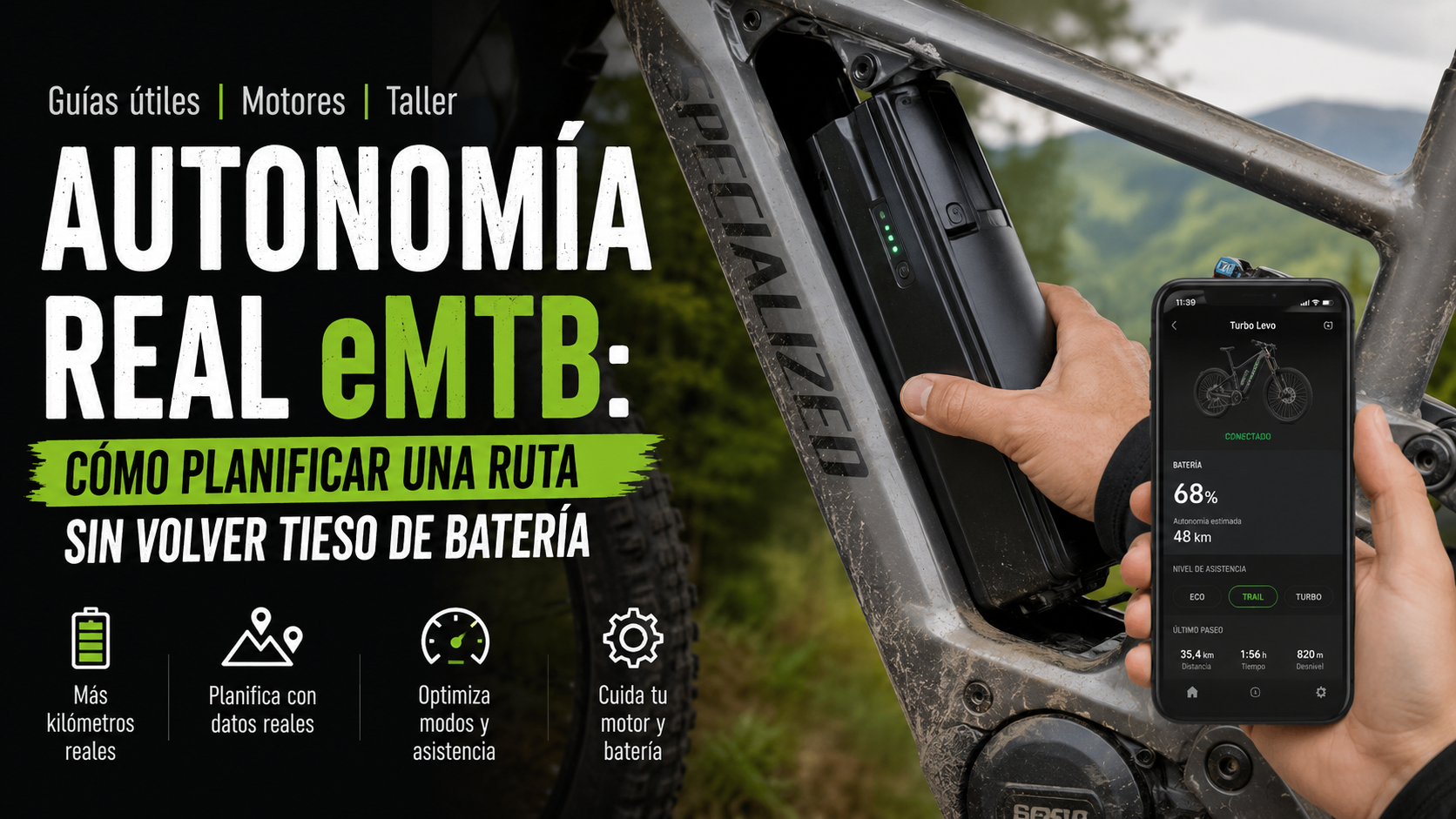
Real eMTB range: plan a ride without running out of battery
Real eMTB range: plan a ride without running out of battery
An eMTB's real-world range depends on more than battery Wh. It depends on weight, elevation gain, terrain, assistance mode, cadence, temperature, tyre pressure, wind, battery condition and riding style. That is why two bikes with the same battery can deliver very different ranges.
Ideal cadence recommended by Bosch to maximise range.
Temperature used by Shimano in its range test conditions.
Rider weight used by Shimano in its test conditions.
Wh is available energy, not guaranteed kilometers.
The common mistake: assuming a 750 Wh battery always delivers plenty of kilometres
A large battery helps, but it cannot work miracles. On an eMTB, what matters is not just distance but elevation gain, terrain and the assistance mode used. Riding 40 km on a flat, hard-packed track does not use the same energy as 40 km of rough trail with 1,500 m of elevation gain.
Advertisement / sponsored link
Real-world range depends on an equation with many variables. Bosch makes this clear in its guides: temperature, cadence, tyre pressure, weight, starts and stops, gear shifting and terrain all directly affect range.
Chart 1: the factors with the greatest effect on range
This graph summarizes the practical impact of each factor on a real eMTB route. It is not a universal figure, but a visual scale to understand priorities.
Impact on battery consumption
What Wh really means in an eMTB battery
Wh, or watt-hours, indicate stored energy. In simplified terms, a 750 Wh battery can deliver 750 W for one hour, 375 W for two hours or 250 W for three hours. In practice, the system does not operate at a constant output: it varies with gradient, mode, cadence, speed and terrain.
Simple relationship between average power consumption and theoretical runtime
Elevation gain matters more than kilometres
On the road or in town, distance is usually a useful guide. Not on an eMTB. In the mountains, elevation gain can drain the battery much faster than distance. A 25 km ride with 1,400 m of climbing may use more energy than a 55 km ride with 500 m.
A battery-friendly ride
- 40-60 km
- hard-packed track
- little elevation gain
- Eco/Tour mode
- fluid cadence
A battery-draining ride
- 25-35 km
- technical trail
- a lot of elevation gain
- frequent Trail/Turbo use
- repeated starts and slow sections
Advertisement / sponsored link
Figure 2: estimated consumption by route type
Relative consumption by scenario
A practical way to plan a ride without running out of charge
You do not need a perfect formula. You need a conservative method. The key is to set off with a reserve and check your decision points during the ride.
Calculate distance and elevation gain
Do not look only at kilometres. Note the elevation gain and locate the long climbs.
Divide the route into thirds
The first third, halfway and the final third. At each point, check your remaining battery charge and the climbing still ahead.
Keep battery charge in reserve for the return
Do not use half your battery before halfway if there is still plenty of climbing ahead. On unfamiliar routes, keep at least 20-30% in reserve.
Advertisement / sponsored link
Advertisement / sponsored link
Use Turbo only as a tool
Save Turbo for particular steep climbs, technical sections or brief moments. If you use it as your default mode, range drops quickly.
Have a plan B
Before setting off, identify exit options, roads, villages or ways to shorten the route if the battery drains faster than expected.
Quick table: battery remaining and smart decision
| Status | Correct reading | Recommended decision |
|---|---|---|
| 50% of the route completed and 65% battery remaining | You're doing fine. | Maintain your assistance modes and cadence. |
| 50% of the route completed and 50% battery remaining | Tight, but under control. | Drop one assistance mode on long climbs. |
| 50% of the route completed and 35% battery remaining | High risk. | Shorten the route or switch to Eco. |
| The hardest climb is still ahead and you have 25% charge | Dangerous situation. | Don't use Turbo unless you have an emergency. |
| The final 5 km are downhill and 15% battery remains | Probably enough. | Use minimal assistance. |
Cadence: the low-cost way to gain range
Bosch recommends a cadence of 60 to 90 rpm for maximum range. This makes sense: grinding at low cadence forces the motor to work under greater load and less efficiently. On climbs, shift to a lower gear, increase cadence and let the motor spin more smoothly.
Pedal efficiency according to cadence
Tyre pressure: range versus grip
Bosch recommends using the maximum permitted pressure to maximise range. In real-world eMTB riding, especially in the mountains, efficiency must be balanced with grip and rim protection. Higher pressure reduces rolling resistance, but too much can reduce grip and control.
More pressure
- Less rolling resistance.
- More range.
- Less tyre squirm.
- Less grip on broken ground.
Less pressure
- More grip.
- More comfort.
- More consumption.
- Greater risk of rim strikes if you go too low.
Temperature: why you cover fewer kilometres in winter
Bosch explains that lower temperatures increase a battery's internal electrical resistance, so a temporary reduction in range can be expected. Shimano also notes that cold can drain the battery faster, just as with a mobile phone in winter.
Relative range by temperature
Assist mode: where the battery really goes
Eco, Tour, Trail, eMTB, Auto, Turbo... each brand uses its own names, but the principle is the same: the more assistance you ask of the motor, the more energy it draws from the battery. A common mistake is using Turbo because "it makes riding easier", then being surprised when the charge percentage plummets.
Relative consumption by mode
Battery management by stage: how to ride sensibly
First stage. Do not waste energy on Turbo. Warm up your legs and assess actual consumption.
Check stage. If you have used too much energy, change the plan.
Critical section. Decide here whether to complete the route, shorten it or conserve battery charge.
Final stage. Use minimal assistance if charge is already running low.
Table: estimating whether your battery will last
| Planned route | Risk of running out of battery | Recommendation |
|---|---|---|
| 30 km, 500 m+, easy track | Low | Eco/Tour, cadence 60-90 rpm. |
| 40 km, 1,000 m+, mixed trail | Medium | Check at halfway and use Turbo only briefly when needed. |
| 45 km, 1,500 m+, technical trail | High | Set off at 100%, have a plan B and keep at least 25% in reserve. |
| 60 km, 2,000 m+, mountain | Very high | Range extender, second battery or a route with exit options. |
Illustrative table. Results vary considerably with system, battery, fitness, weight, temperature and terrain.
Range extenders and dual batteries: when they are worthwhile
Range extenders make sense for long rides, Alpine stages, bikepacking or unfamiliar routes with plenty of climbing. Specialized, for example, states that its SL Range Extender has a capacity of 160 Wh and provides up to one additional hour of riding on its Turbo SL system. Other systems offer additional batteries or DualBattery configurations.
Comparative energy capacity
Advertisement / sponsored link
Checklist before leaving
Battery and system
- Battery at 100% for a long ride.
- Updated firmware if applicable.
- App or display checked.
- Assist mode configured.
- Charger or range extender if the route requires it.
Route and terrain
- Real distance.
- Elevation gain.
- Terrain type.
- Escape points.
- Expected temperature.
Bike
- Tyre pressure.
- Chain lubricated.
- Drivetrain clean.
- Brakes checked.
- Tires without damage.
Rider
- Water and food.
- Right clothes.
- Basic tools.
- Charged mobile phone.
- Do not rely entirely on Turbo.
Frequently Asked Questions
Is it better to stay in Eco to save energy?
Not necessarily. Eco saves energy, but if you are grinding at low cadence and struggling too much, your pedalling can become less effective. Ideally, use the lowest mode that lets you maintain a smooth cadence.
Does turbo always consume a lot?
Yes, compared with lower modes. Save Turbo for particular steep climbs, technical sections or brief moments. Using it as your main mode greatly reduces your range reserve.
Can cold reduce range?
Yes. Bosch and Shimano state that cold reduces battery performance. Store the battery indoors before setting off and expect less range in winter.
Is higher tyre pressure always better?
It helps with range. For grip and control in the mountains, not always. Find a balance based on terrain, weight and tyre casing.
Is the bike app's range prediction accurate?
It is an estimate. Bosch warns that its calculations may differ from actual results because of riding conditions and external factors. Use it as a guide, not an absolute truth.
Conclusion
Plan an eMTB's real-world range using data, not optimism. Consider distance, elevation gain, temperature, terrain, tyre pressure, cadence and assistance mode. If the route is unfamiliar or involves a lot of climbing, allow a reserve and prepare a plan B.
The practical formula is simple: a cadence of 60 to 90 rpm, Turbo only when needed, correctly adjusted tyre pressures, a well-maintained battery and a consumption check halfway through. This makes it much less likely that you will finish with a flat battery.
Have you used this bike, motor or component?
Join eRIDERSeMTB on Telegram to discuss real experiences with other riders: Bosch, Avinox, Shimano, deals, faults and buying decisions. The community currently speaks Spanish.
Join TelegramAdvertisement / sponsored link
Advertisement / sponsored link
Advertisement / sponsored link
Advertisement / sponsored link