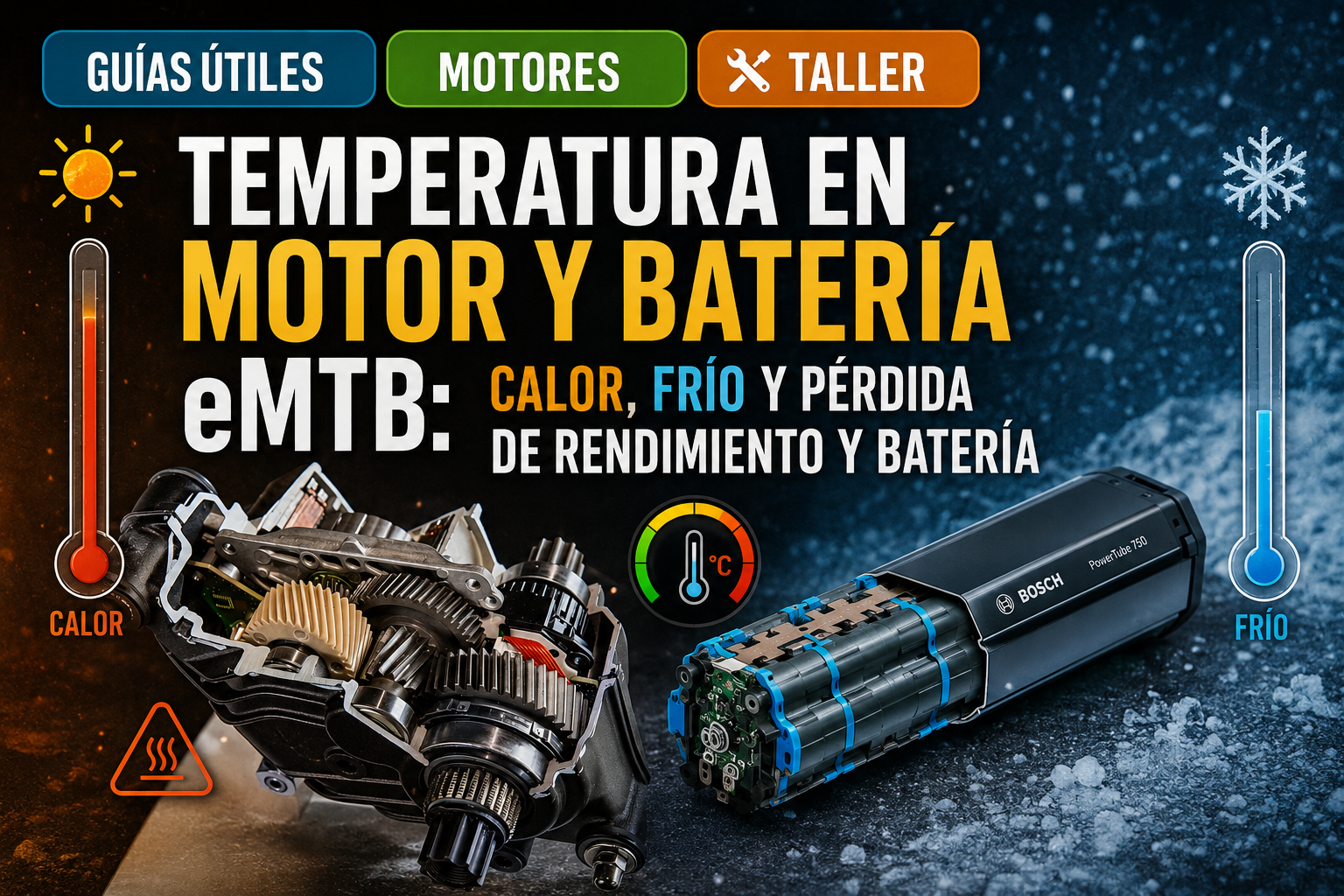
eMTB motor and battery temperature: heat, cold and reduced performance
eMTB motor and battery temperature: heat, cold and reduced performance
Heat and cold directly affect an eMTB's power, range, battery lifespan and motor behaviour. This guide explains what happens, how to recognise it and how to avoid damage.
Quick summary
An eMTB performs differently in summer and winter. The motor is particularly affected by heat, while the battery loses efficiency in cold conditions. Outside the ideal temperature range, the system may reduce power, limit assistance or use more energy to cover the same distance.
Advertisement / sponsored link
1. Why temperature affects an eMTB
Motor, battery, controller and BMS work together. When we request strong assistance, the battery supplies current and the motor converts it into torque. Some energy becomes heat. If the system gets too hot, the electronics reduce power for protection.
2. The motor: heat is the main enemy
An electric motor generates heat under heavy load. This happens on long climbs, slow technical trails, with continuous Turbo use, high total weight or low cadence.
- More heat = more stress on windings and electronics.
- Higher temperature = possible automatic power reduction.
- Low cadence = greater motor strain and more heat.
- Slow climbs = little airflow and greater heat build-up.
Chart: motor thermal risk by use
Eco mode on the flat
Trail on a moderate climb
Turbo on a long climb
Turbo + low cadence + heat
3. Symptoms of motor overheating
| Symptom | What can it mean? |
|---|---|
| The bike delivers less assistance | Automatic power reduction due to temperature. |
| Slower response | The controller limits current to protect the system. |
| Louder noise | Higher temperature, vibration or mechanical load. |
| Temporary cut-out | Severe thermal protection intervention. |
4. The battery: cold reduces range
Lithium batteries perform worse in the cold. At low temperatures, internal resistance rises, current delivery capacity falls and the BMS may limit power to protect the cells.
Chart: estimated range by temperature
20 ºC
10 ºC
0 ºC
-5 ºC
-10 ºC
5. Quick temperature-adjusted range calculator
Estimated baseline range: 60 km
Temperature-adjusted range:
Indicative calculation. Actual range depends on weight, elevation gain, tires, assistance mode, pressure, wind and battery condition.
6. Heat in summer: what to do
- Avoid continuous Turbo use on long climbs.
- Keep a brisk cadence, ideally above 60 rpm.
- Do not strain the motor at low speed in high gears.
- Take short breaks if you notice power dropping.
- Don't leave the battery in the sun inside the car.
- Charge the battery in a ventilated area away from extreme heat.
7. Cold in winter: how to protect the battery
- Keep the battery indoors before setting off.
- Do not charge an ice-cold battery immediately on returning.
- Take it easy for the first few minutes of the ride.
- Plan for less range than in summer.
- Avoid leaving the bike all night at temperatures below zero.
8. Practical table of temperature and behaviour
| Temperature | Main effect | Recommendation |
|---|---|---|
| -10 ºC to 0 ºC | Significant range loss | Store the battery indoors and avoid demanding high power at the start. |
| 0 ºC to 10 ºC | Lower efficiency | Plan your ride with battery capacity to spare. |
| 15 ºC to 25 ºC | Ideal range | Optimum performance. |
| 30 ºC to 35 ºC | More thermal stress | Avoid prolonged Turbo. |
| 35 ºC+ | Risk of power limiting | Breaks, high cadence and lower assistance. |
9. Modern motors: more power, more heat
The current eMTB trend is clear: more powerful motors, more torque and higher peak wattage. This improves response on steep climbs but also increases thermal demands. The more torque and power requested, the more important temperature management becomes.
Technical conclusion
A very powerful motor cannot always deliver maximum output continuously. Peak power is one thing; sustained power on a long, hot climb is another.
10. Final tips for taking care of motor and battery
- Use lower gears on climbs.
- Don't abuse the Turbo if you don't have to.
- Avoid storing batteries at 100% for many days.
- For storage, a battery charge between 40% and 70% is preferable.
- Do not charge immediately after a very hot ride.
- Do not pressure-wash the motor, battery or connector areas.
- Update firmware when the manufacturer recommends it.
Conclusion
Temperature is one of the most important factors for an eMTB. Cold reduces range and heat can limit power. Understanding how the system responds helps avoid surprises, extend battery life and keep the motor in better condition.
Have you used this bike, motor or component?
Join eRIDERSeMTB on Telegram to discuss real experiences with other riders: Bosch, Avinox, Shimano, deals, faults and buying decisions. The community currently speaks Spanish.
Join TelegramAdvertisement / sponsored link
Advertisement / sponsored link
Advertisement / sponsored link
Advertisement / sponsored link