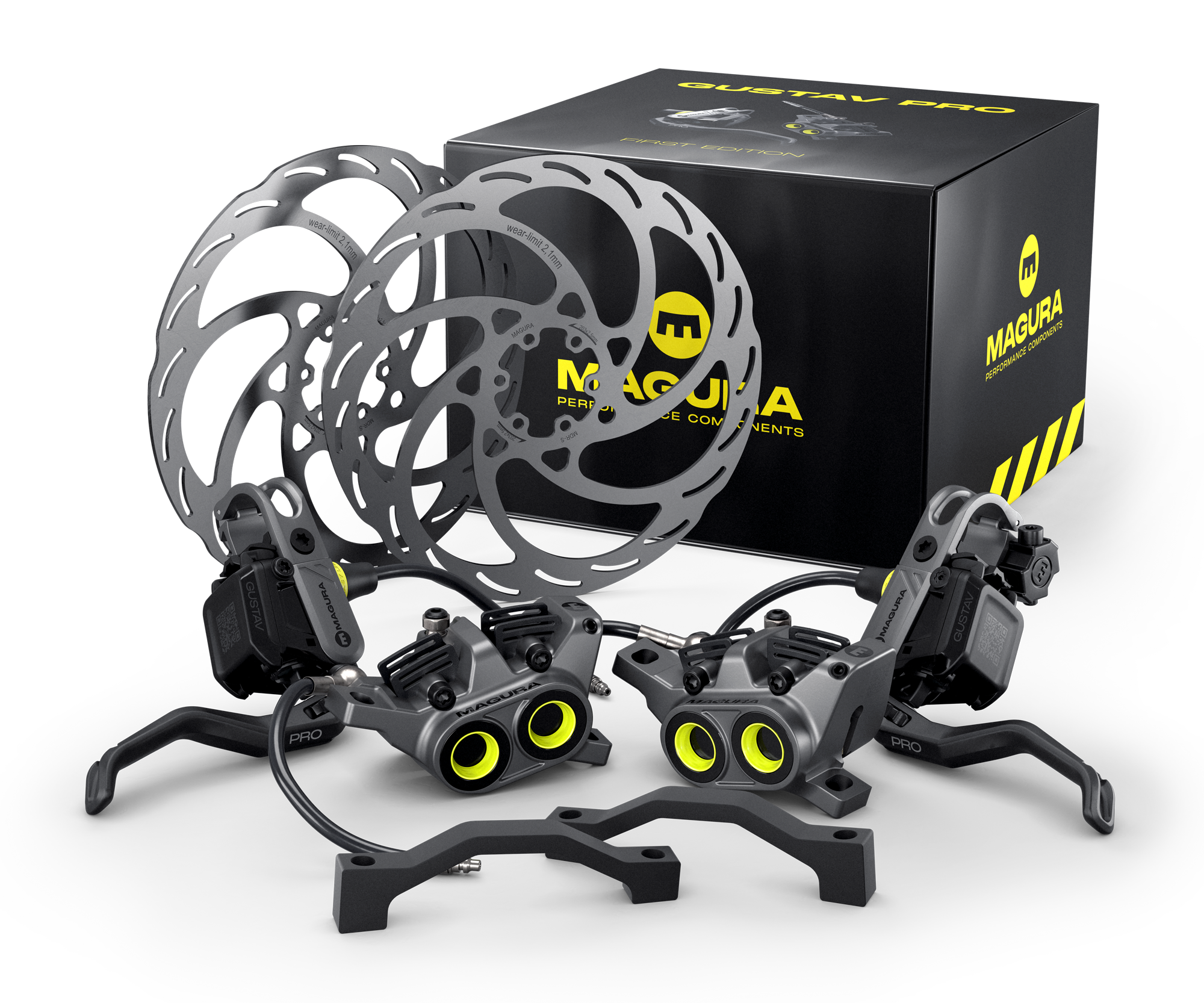
MAGURA GUSTAV PRO for eMTBs: 2.5 mm rotors, Easy Link and compatibility without surprises
Technical guide · eMTB PRO
What a 2.5 mm rotor offers, what you can keep from an MT setup and what the workshop must check before fitting GUSTAV PRO to your eMTB.
Advertisement / sponsored link
Before buying a stronger brake, identify what is missing
Do not choose a brake for how imposing it looks in a photograph. Think about the final part of a descent, when you want to keep modulating without every corner becoming a struggle for your fingers. MAGURA GUSTAV PRO is particularly relevant when reassessing an eMTB's complete braking system: comparing two levers while leaving everything else out is not enough.
This guide, revised on , examines official documentation; it is not our own test and does not claim riding impressions. Its aim is to separate three decisions: replacing the brake, choosing a rotor and finalising a compatible installation.
Start by describing the problem without diagnosing it: does discomfort occur immediately or after several minutes? Does lever travel change? Is braking difficult, or is the lever difficult to reach? Take these observations to the workshop. Buying around an assumed cause may leave you with new equipment and the same unanswered question. A more capable component does not replace maintenance of your existing system either.
GUSTAV PRO is not an MT7 with a larger caliper
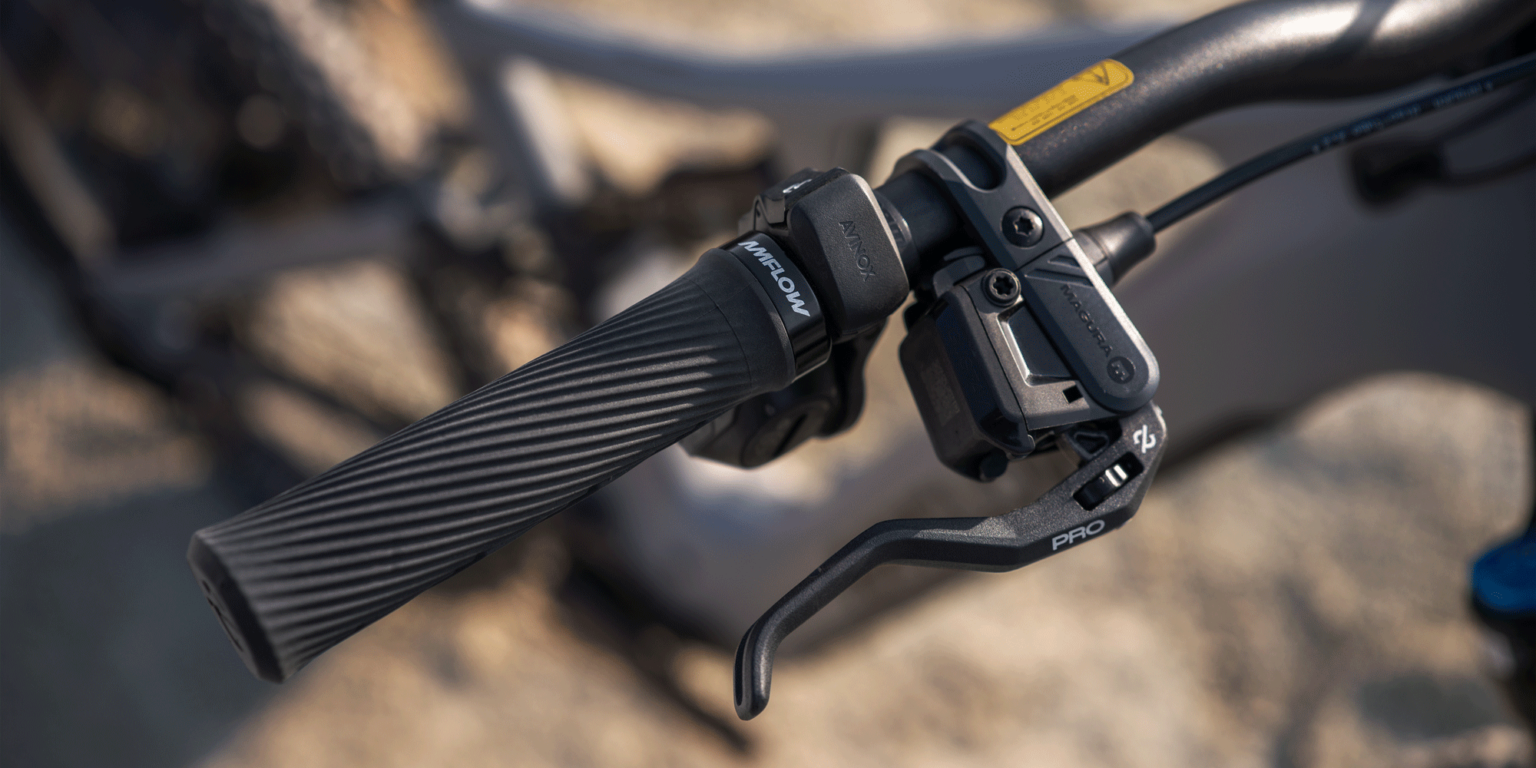
The official GUSTAV PRO specification sheet specifies a 12 mm master piston and four 19 mm pistons in a one-piece aluminium caliper. The lever body is Carbotecture; the PRO lever blade and clamp are aluminium. Reach is adjustable without tools. By contrast, the MT7 PRO uses diameters of 10 and 17 mm respectively, and a nominal 2.0 mm rotor.
Advertisement / sponsored link
The important technical point is that both ends of the hydraulic circuit change. Counting pistons or measuring only those in the caliper cannot establish final force at the wheel: the master cylinder, lever geometry, friction and rotor also contribute. Promising a percentage improvement from two diameters therefore makes no sense.
For an upgrade, compare complete setups. Ask what differences remain after including rotors, adapters and consumables, and which solves your specific problem. A considered purchase may lead to GUSTAV, but also to keeping a properly serviced MT7. You do not need to dismiss one brake to justify another being better suited to a particular use.
What changes with 2.5 mm and what you can't take for granted
The MDR-S 2.5 has a nominal thickness of 2.5 mm and a wear limit of 2.1 mm. The specification sheet consulted lists 180 and 203 mm versions, both six-bolt. MAGURA links its greater mass and stiffness to thermal stability and reduced vibration.
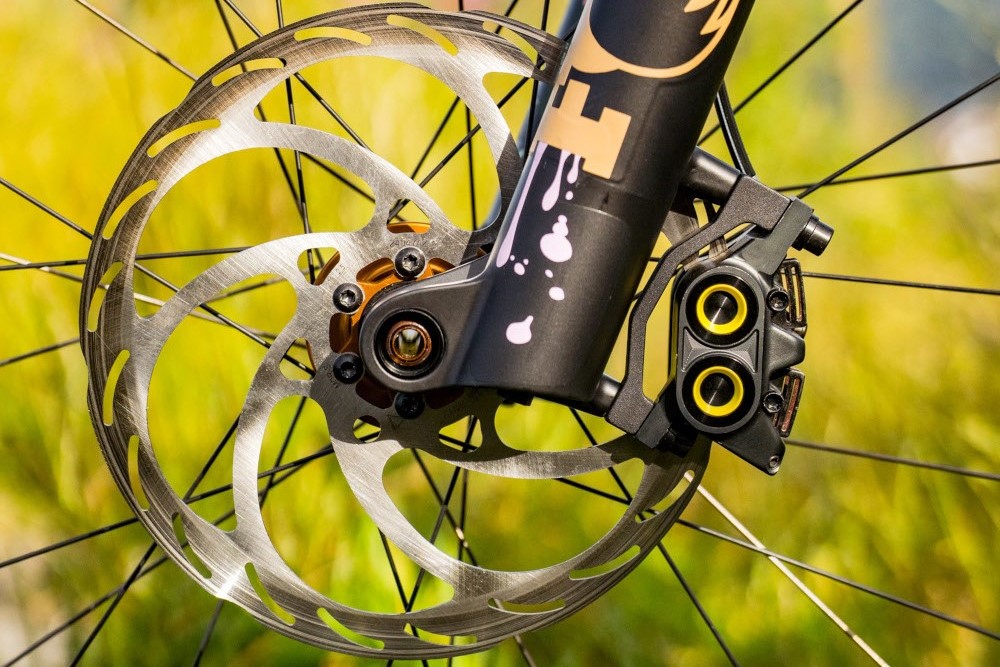
Understand the mechanism without turning it into a promise. In physical terms, a component with greater heat capacity can absorb more energy for the same temperature rise. But temperature during a descent also depends on braking time, cooling and the energy entering the system. Thickness does not make a brake immune to heat.
Nor does it replace diameter. Diameter changes the lever arm through which braking force acts; thickness addresses a different part of the problem. We would not consider a small, thick rotor equivalent to a large, thin one without comparing the complete system. Establishing that equivalence would require a controlled test, not a buying rule.
Finally, nominal and minimum mean different things: the former identifies the new product; the latter marks its service limit. A thickness reading alone never turns a worn rotor into another approved model.
MDR-S, MDR-P and MT: a table to look beyond the acronyms
GUSTAV PRO accepts MAGURA rotors of 2.0 or 2.5 mm. This allows consideration of retaining existing rotors, but does not authorise every diameter, condition or installation. The following table distinguishes product families; it does not replace approval for your bike.
| Rotor | Distinguishing specification | Practical decision |
|---|---|---|
| MDR-S 2.5 | 2.5 mm; minimum 2.1 mm | An option for GUSTAV; do not fit it to a conventional MT. |
| MDR-S 2.0 | 2.0 mm; minimum 1.8 mm | Do not confuse it with the 2.5 because they share a name. |
| Six-bolt MDR-P | 2.0 mm; minimum 1.8 mm; two-piece construction | Assess reuse by product reference and condition, not diameter alone. |
The specification sheets for MDR-S 2.0 and MDR-P document these differences. The MT manual does not permit a new 2.5 mm rotor: do not force it between the pads or modify parts to make it fit.
Consider your second wheelset too. An incomplete conversion may work with the newly prepared wheels while leaving the spare set unresolved. Record each wheel's rotor reference, not just 'large front, small rear'.
Easy Link: same connection idea, different compatible parts
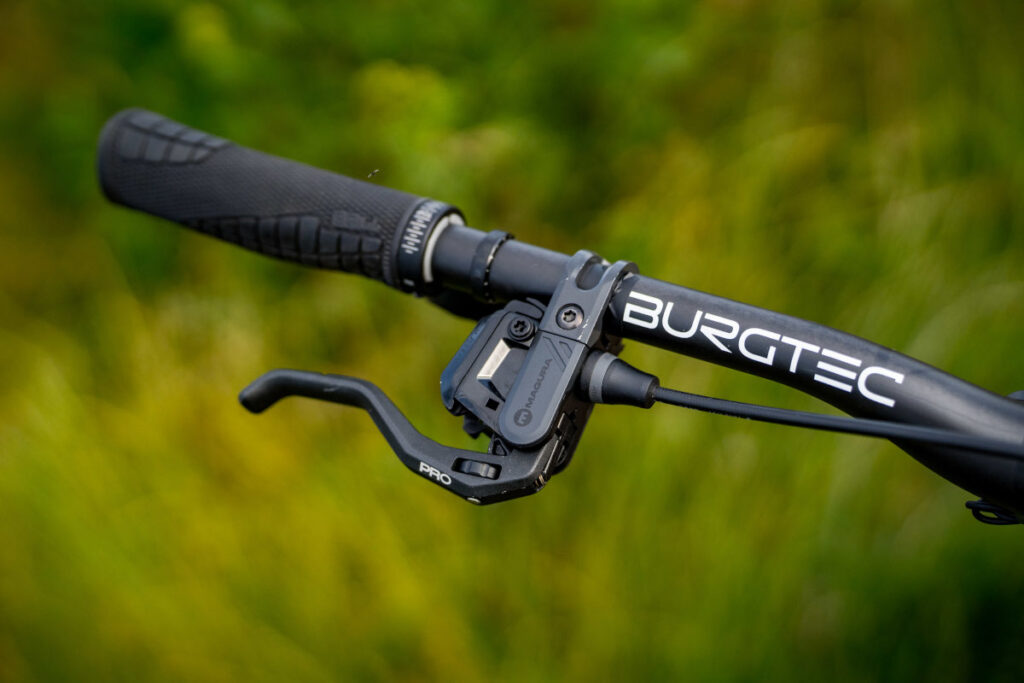
MAGURA Easy Link connects the hose to the brake body; ETT identifies the connection technology. GUSTAV PRO incorporates it. Adapter valves are available for MT and MT C, but require crimped fittings: threaded ETT fittings are not compatible with them. The ETT table for MT confirms that restriction; the GUSTAV/LOUISE table covers threaded and crimped fittings.
Advertisement / sponsored link
This distinction resolves a common confusion: being able to connect a hose does not prove that mixing a lever and caliper is approved. Hydraulic continuity and compatibility of the complete brake are separate questions. I would not propose an MT/GUSTAV combination without express confirmation from MAGURA for those product references.
Advertisement / sponsored link
Also distinguish a designed disconnection from replacing components. The current ETT manual linked by MAGURA requires bleeding when the system is opened to replace a hose, fitting or valve. 'It has Easy Link' therefore does not mean 'it never needs bleeding'.
Ask the quote to specify the actual work: retaining a valid connection, adapting the routing or replacing the hose. That compares real operations, not two offers calling different jobs 'installation'. This article does not describe making or modifying fittings.
Three measurements before touching a bolt
Give the workshop the frame model and year, exact fork and hub reference. Then separate three checks: rotor attachment to the hub, permitted diameter and caliper adaptation. These are different interfaces; resolving one does not automatically resolve the others.
The MAGURA adapter guide links the choice to the frame or fork mount and rotor size. An adapter does not authorise exceeding the bike's maximum. A shop advertising it as 'for 203' is not enough either: the starting mount standard matters.
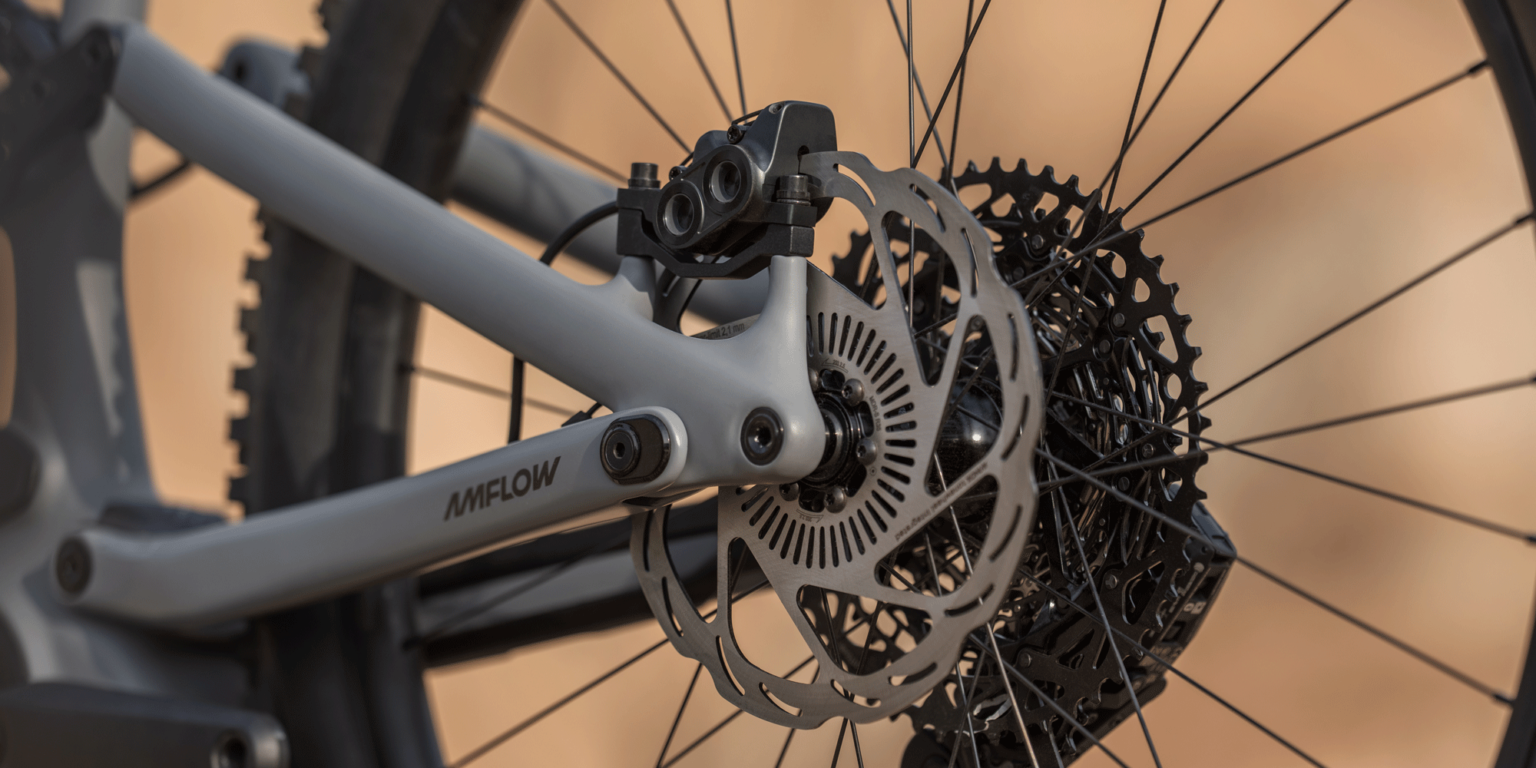
There is a particularly useful warning for Centerlock wheels. The rotor manual allows the MAGURA adapter with MDR-S up to 203 mm, but prohibits using it with MDR-P and ABS sensor rings. A MDR-P CL is a specific version, not simply a converted six-bolt MDR-P.
A useful workshop answer contains part references, not general reassurance: front rotor, rear rotor, adapters and fasteners. If a part is unidentified, the quote is not yet final. Keeping a photograph of the previous setup helps explain it, but does not replace technical identification.
Installation starts at your hand and extends to the suspension
Decide handlebar and control positions before finalising hose length. Leaving this until later may send a newly completed installation back to the workshop. Consider gloved use too: the shifter, dropper remote and assistance control must remain accessible without constantly repositioning your hand.
According to the current Shiftmix documentation, GUSTAV uses the IG interface. IG.X variants expand adjustment options and are available for SRAM MatchMaker, Shimano I-SPEC EV and SRAM POD AXS. Do not assume an MT's Shiftmix clamp transfers over: identify the interface and control.
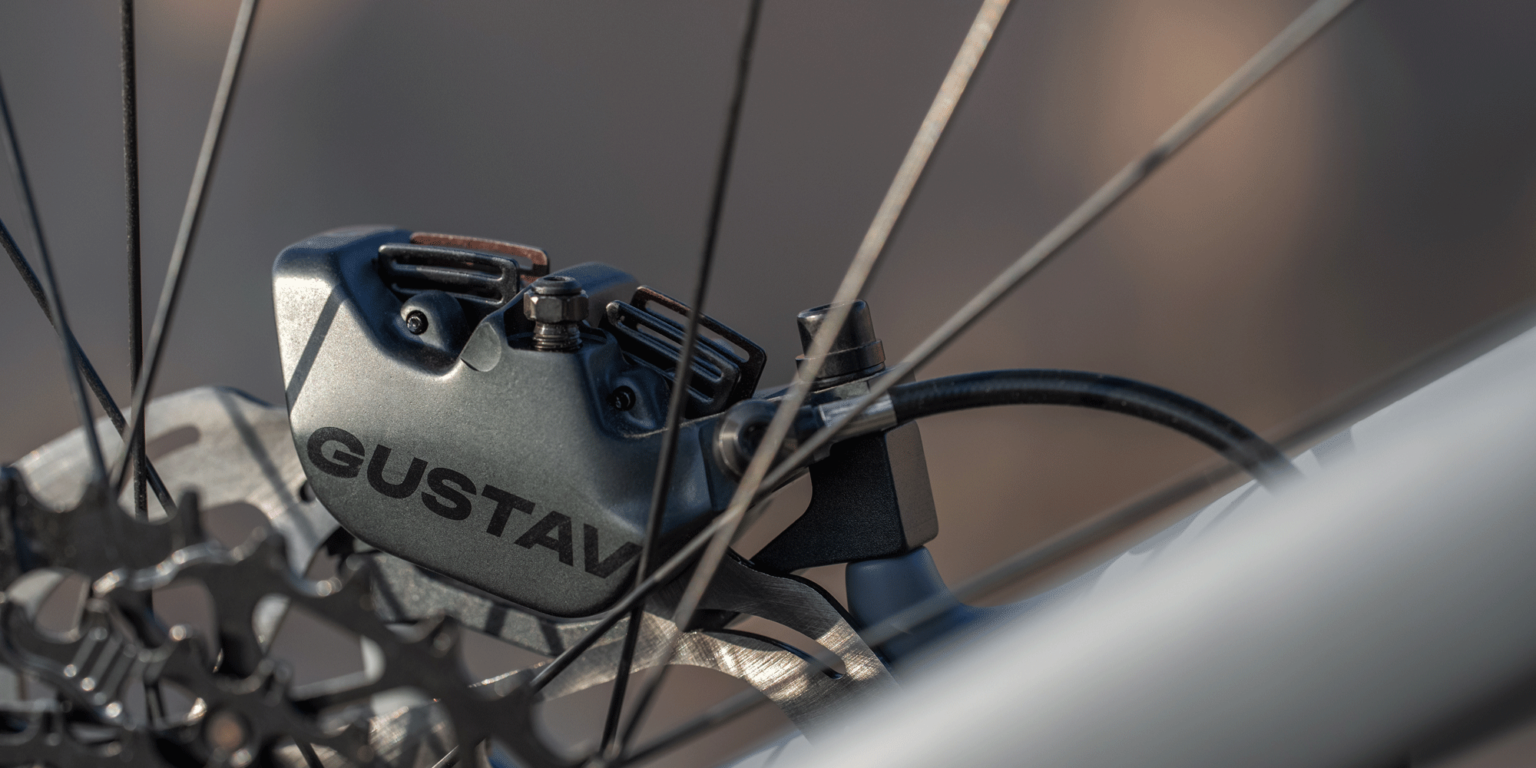
The GUSTAV manual requires routing without pinching or stretching through steering and suspension movement, and at least 20 mm of clearance from the rotor in every position. A stationary photograph does not verify that movement. Ask the workshop to check the full intended range of motion.
Ergonomics also deserves an unhurried handover. Adjust the lever closer or further away within its range and confirm you can hold the grip comfortably. Do not assess reach only while seated in the car park if you will mainly ride standing on descents.
Pads: buy the correct reference, not a lifespan percentage
The current family MDP 13 offers BLACK, SILVER and YELLOW compounds for GUSTAV, with four individual pads per set. The official support of the series retains the 13.S designation for part 2703067, while its GUSTAV PRO specification lists MDP 13 BLACK. These overlapping names make checking the code particularly useful when ordering replacements.
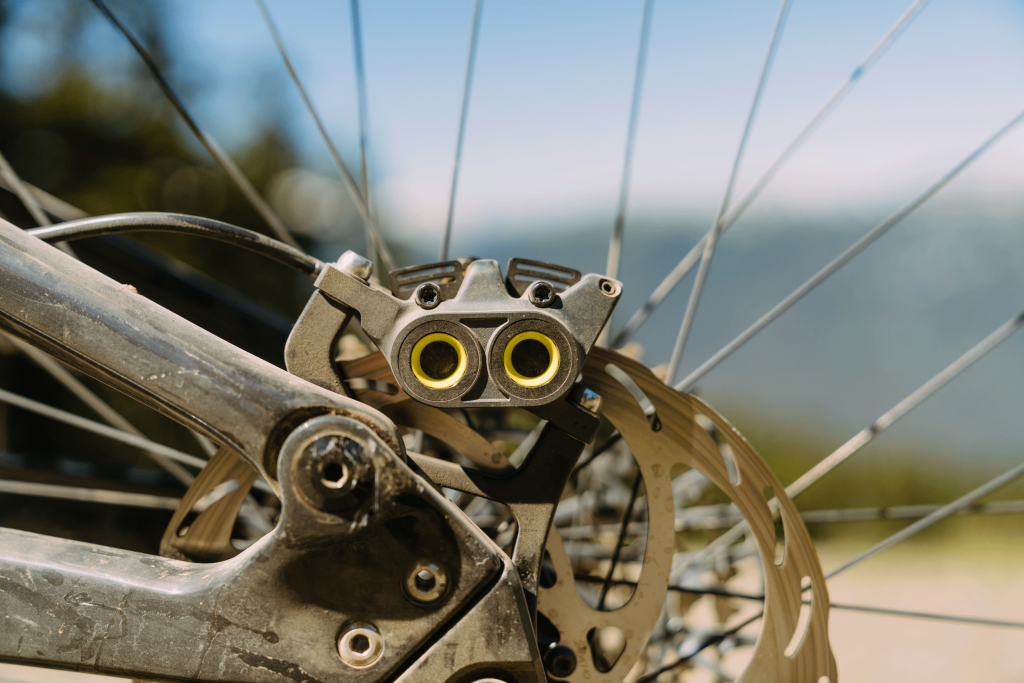
When preparing a trip, knowing which part reference your shop can supply matters more than memorising a lifespan claim. Order the correct set for your brake and keep a photograph of the packaging. If travelling with another bike using MT, label both bags: 'MAGURA four-piston pads' is not precise enough.
Choose the compound with a clear priority and discuss riding conditions: noise that bothers you, the feel you want, usual terrain and inspection frequency. We do not promise kilometres per set or extrapolate another rider's wear. To compare costs, record actual replacements with the date and approximate use. That history is more useful than any universal lifespan.
What should be checked when picking up the bike
The GUSTAV PRO manual specifies a maximum of one QM adapter per caliper, both body covers fitted, a stable bite point and no leaks. It prescribes Royal Blood for the hydraulic system, not DOT. These checks are not optional because the system comes pre-filled.
Request a handover sheet with fitted part references and tightening checks against the brake, rotor, frame and fork manuals. We do not provide a generic torque: different bolts serve different functions. Also keep the equipment needed to transport the bike and the instructions for your exact version.
The MAGURA rotor manual requires new pads when fitting a new rotor and bedding-in before the intended braking capability is reached. Schedule this before a demanding ride, not at the start of a holiday with the group waiting.
If you find leaks, damage or a changing bite point, do not ride to see 'if it improves'. The manufacturer requires inspection if there is any doubt about brake condition. Familiarization is not a stress test or a test to discover the thermal limit.
Advertisement / sponsored link
Three cases in which the decision changes
Your MT works well and you do varied rides. There is no need to replace it. First request a service and a compatible consumables proposal. Compare keeping it with a complete replacement, including items you could no longer reuse. The more expensive option must offer a benefit you actually need.
You are preparing an eMTB for prolonged descents. Here GUSTAV is worth considering as a complete system. Request two quotes: retaining approved rotors in good condition, or moving to the 2.5 mm system. This shows what you pay for the brake and for renewing everything else. Do not choose a rotor simply because it appears in a promotional package.
Your bike has ABS. Put the purchase on hold until the system and configuration are identified. MAGURA associates GUSTAV with Touring, Allroad and Trail modes; MT7 with ABS Race. 'ABS compatible' does not mean interchangeable with every ABS-equipped bike.
Our editorial recommendation is to consider GUSTAV when the complete installation suits your use and is easy for you to maintain. If using it depends on an unconfirmed combination, the decision remains open. The best quote is not the one with the fewest lines: it leaves the fewest technical questions unanswered.
Questions worth taking in writing
Before approving the work, ask five questions: what will you retain? Which new part references will be fitted? Which compatibilities are documented? What operations does labour cover? Which consumables should you have available? These are not formalities: they let you compare offers covering the same work.
When checking the result, distinguish configuration from riding experience. You can check fitted parts and completed inspections; you still need to get used to the feel in safe conditions. No photograph, specification sheet or editorial opinion replaces that personal adaptation.
The final point is simple: buying GUSTAV PRO is not about adding half a millimetre to any brake. It means choosing a system, deciding which components fit together and requiring a coherent installation. Once these three questions are answered, the name on the caliper stops being the main argument and becomes what it should be: identification of a well-considered choice.
Sources and documentation
Information checked on 24 September 2026. Editorial guide based on official documentation, not our own ride test. Equipment and availability may vary by market.
- GUSTAV PRO: current official specification sheet
- MT7 PRO: current official specification sheet
- MDR-S 2.5: specifications
- MDR-S 2.0: specifications
- Six-bolt MDR-P: specifications
- MT: manual currently linked from the MT7 product page
- ETT and Easy Link valves
- ETT MT and MT C matrix
- ETT GUSTAV/LOUISE matrix
- ETT: currently linked instructions, August 2026 file
- MAGURA adapters
- MAGURA rotor installation
- MDR-P CL: Centerlock variant
- Shiftmix, IG and IG.X
- GUSTAV PRO: currently linked manual
- MDP 13: current pad family
- GUSTAV support and spare parts
- MAGURA Components for ABS
Have you used this bike, motor or component?
Join eRIDERSeMTB on Telegram to discuss real experiences with other riders: Bosch, Avinox, Shimano, deals, faults and buying decisions. The community currently speaks Spanish.
Join TelegramAdvertisement / sponsored link
Advertisement / sponsored link
Advertisement / sponsored link