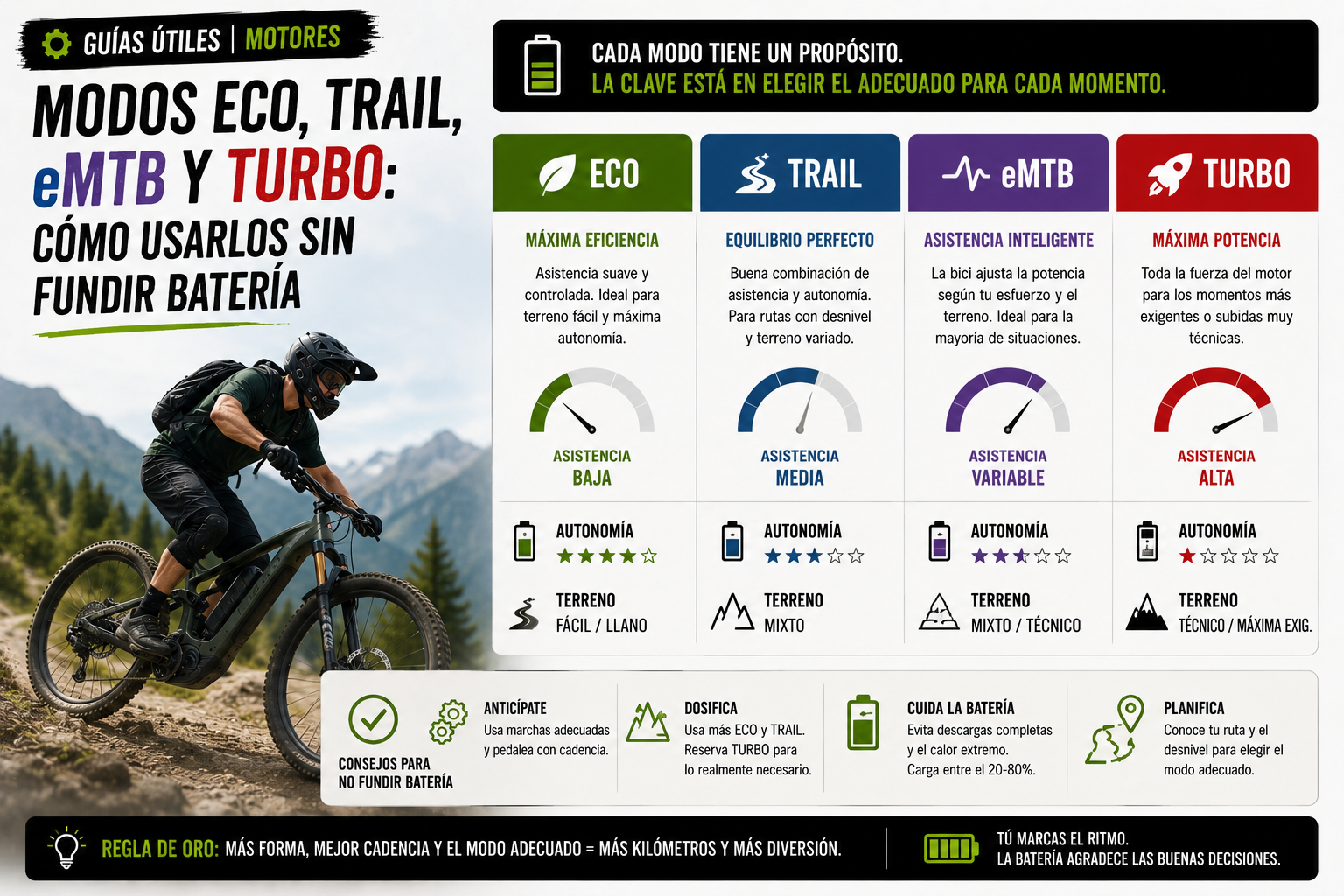
Eco, Trail, eMTB and Turbo modes: how to use them without draining the battery
A successful ride is not about staying in Turbo all the time. It is about knowing when to save energy, when to push and when to let the bike work.
The key
With eMTBs, almost everything looks easy until you combine weight, motor, battery, mud, heat and maintenance. That is why we do more than repeat numbers: we look at what happens when you actually ride.
Advertisement / sponsored link
Advertisement / sponsored link
| Point | Why it Matters | Typical error |
|---|---|---|
| Eco | Save energy and keep rolling | Grinding up steep climbs in a high gear |
| Trail/eMTB | The versatile mode | Assuming it always uses little energy |
| Turbo | Steep climb or emergency | Making it your default mode |
eMTB PRO opinion
If a brand wants us to test something, great. Supplied products, loans or campaigns will be clearly disclosed. What cannot be bought is the conclusion. If it works well, we will say so. If it has drawbacks, we will say that too.
Sources and references
Eco, Trail, eMTB and Turbo modes: when to use each sensibly
The right mode is not always Turbo or always Eco. It is the one that lets you finish the ride with control, battery charge and energy in your legs.
The simple rule: choose the mode for the terrain, not your pride
Some riders stay in Eco all day to show off; others stay in Turbo because the bike allows it. Both extremes can be pointless. On an eMTB, assistance mode is a tool, like changing gear. Switch often, and before a problem arrives.
Eco is for linking sections, easy gravel tracks and conserving battery. Trail or eMTB is often smartest for real rides because it adjusts assistance to pedal pressure. Turbo is for steep climbs, fatigue, specific sections or clearing a step without stalling.
Advertisement / sponsored link
| Status | Recommended mode | Why | Typical error |
|---|---|---|---|
| Easy gravel track | Eco | You save battery and keep pace | Using Turbo because “that's what it's there for” |
| Rough uphill trail | Trail/eMTB | A better balance of traction and energy use | Grinding in Eco with too high a gear |
| Short, very steep climb | Turbo | Brief assistance to avoid putting a foot down | Entering too late and at the wrong angle |
| Near the end of a ride with little battery left | Eco + high cadence | The motor works more efficiently and uses less energy | Continuing to push in a high assistance mode |
Battery use depends on more than the mode
Mode matters, of course. So do rider weight, soft-compound tires, low pressures, mud, temperature, elevation gain, wind and a dirty drivetrain. Two identical bikes can have completely different ranges if one rider pedals smoothly and the other stamps on the pedals.
How I would explain it on the trail
If you are in Eco but the bike feels lifeless and you are grinding hard, you are not saving as much as you think. If you use Turbo on a loose climb, you may not climb further: you may simply spin more. The trick is a lively cadence, a sensible gear and changing modes before you get caught out.
Have you used this bike, motor or component?
Join eRIDERSeMTB on Telegram to discuss real experiences with other riders: Bosch, Avinox, Shimano, deals, faults and buying decisions. The community currently speaks Spanish.
Join TelegramAdvertisement / sponsored link
Advertisement / sponsored link
Advertisement / sponsored link