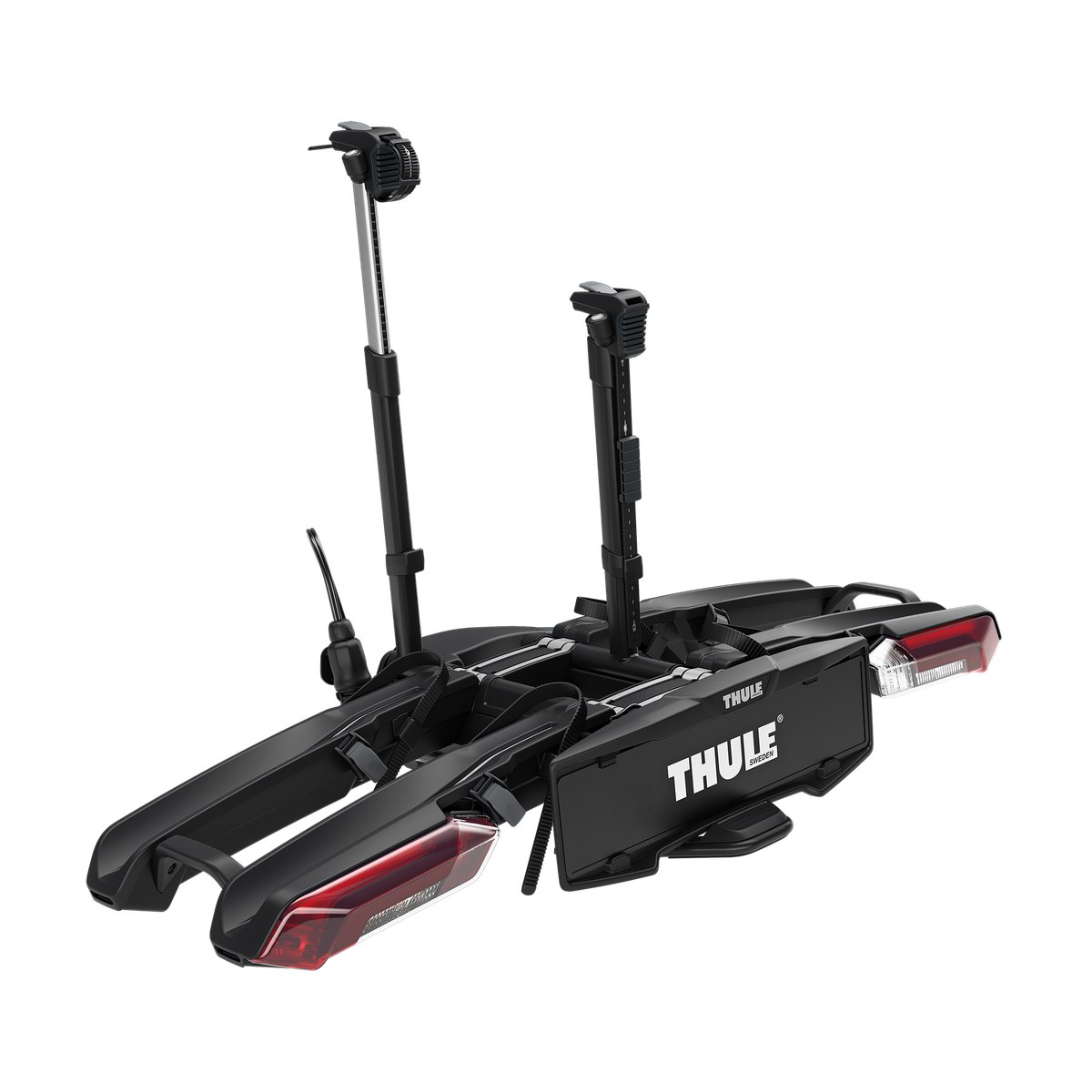
Thule Epos for heavy eMTBs: calculate the real load before choosing two or three bike spaces
Technical guide · September 2026
The rack's 60 kg rating is only part of the picture. Rack weight, towbar limits, wheelbase and bike attachment also affect your setup.
Advertisement / sponsored link
Epos capacity is only part of the calculation
Two bikes that fit on a rack cannot necessarily travel on that setup. Check that each bike meets its individual limit, their combined weight respects rack capacity and the loaded rack's weight is permitted by the vehicle and towbar. All these conditions must be met together.
The European two-bike Thule Epos, 978100, lists a 60 kg load capacity, a maximum of 30 kg per bike and its own weight of 17.3 kg. We examine that reference and explicitly compare it with the three-bike 979100. We do not apply its specifications to sensor-equipped models, US references or other Thule racks.
This guide combines official documentation with calculated examples; it is not a road test. Buying requires figures for your own car, towbar and bikes prepared for transport. Photographs explain the product but do not themselves certify a specific combination's compatibility.
How to calculate how many kilos are left for bicycles
Thule indicates in its safety instructions that rack and load together must not exceed the permitted towball load. Check both vehicle and towbar and use the most restrictive applicable limit. Do not substitute towing capacity for vertical load: they are different figures.
For the two-bike Epos, the illustrative calculation is permitted vertical load minus the rack's 17.3 kg, also subtracting accessories that add weight. The result remains subject to the product's 60 kg load capacity and individual maximum. The table gives hypothetical examples without additional accessories; it does not approve any vehicle.
| Applicable vertical load limit | Capacity remaining after rack weight | Maximum available for bikes |
|---|---|---|
| 60 kg | 42.7 kg | 42.7 kg |
| 75 kg | 57.7 kg | 57.7 kg |
| 90 kg | 72.7 kg | 60 kg |
All other vehicle limits must also be respected, including axle loads and authorised mass. If a figure is missing, ask the manufacturer or installer before turning an estimate into a buying decision.
Advertisement / sponsored link
Two 26 kg eMTBs: an example that changes with the car
Assume two bikes weighing 26 kg each as transported. Together they weigh 52 kg. Adding the two-bike Epos brings the total to 69.3 kg before other accessories. Against an applicable 75 kg vertical limit, that leaves 5.7 kg in this calculation. Against 60 kg, it exceeds the limit by 9.3 kg.
The same rack and bikes thus produce two different results. No eBike compatibility label changes the arithmetic. Redistributing two identical bikes does not help if the issue is total weight.
To reduce weight, first identify what may be removed under the bike's instructions. Do not assume the battery is removable or quickly detachable. Reweigh the final configuration and arrange suitable transport inside the car for removed parts. A valid calculation is repeatable for every trip and includes everything actually carried on the rack.
Weigh the actual bike with its accessories
A catalogue weight may refer to another size, a build without pedals or a different battery. For a transport rack, the actual bike's weight matters. Check scale capacity and use a weighing method that risks neither the person nor the frame.
List everything carried fitted to the bike: pedals, mudguards, bags and any other items. Then decide what you will routinely remove. A consistent transport configuration is better than improvising every Friday while packing luggage and searching for tools. Keep the result and reweigh after significant changes.
If the bikes have different weights, check each individual limit as well as the total. Being below the combined maximum does not authorise either bike to exceed its per-space limit. This is especially important when pairing a light eMTB with a heavily equipped one. One bike's spare capacity does not automatically permit overloading the other space.
Telescopic arms need an appropriate attachment point
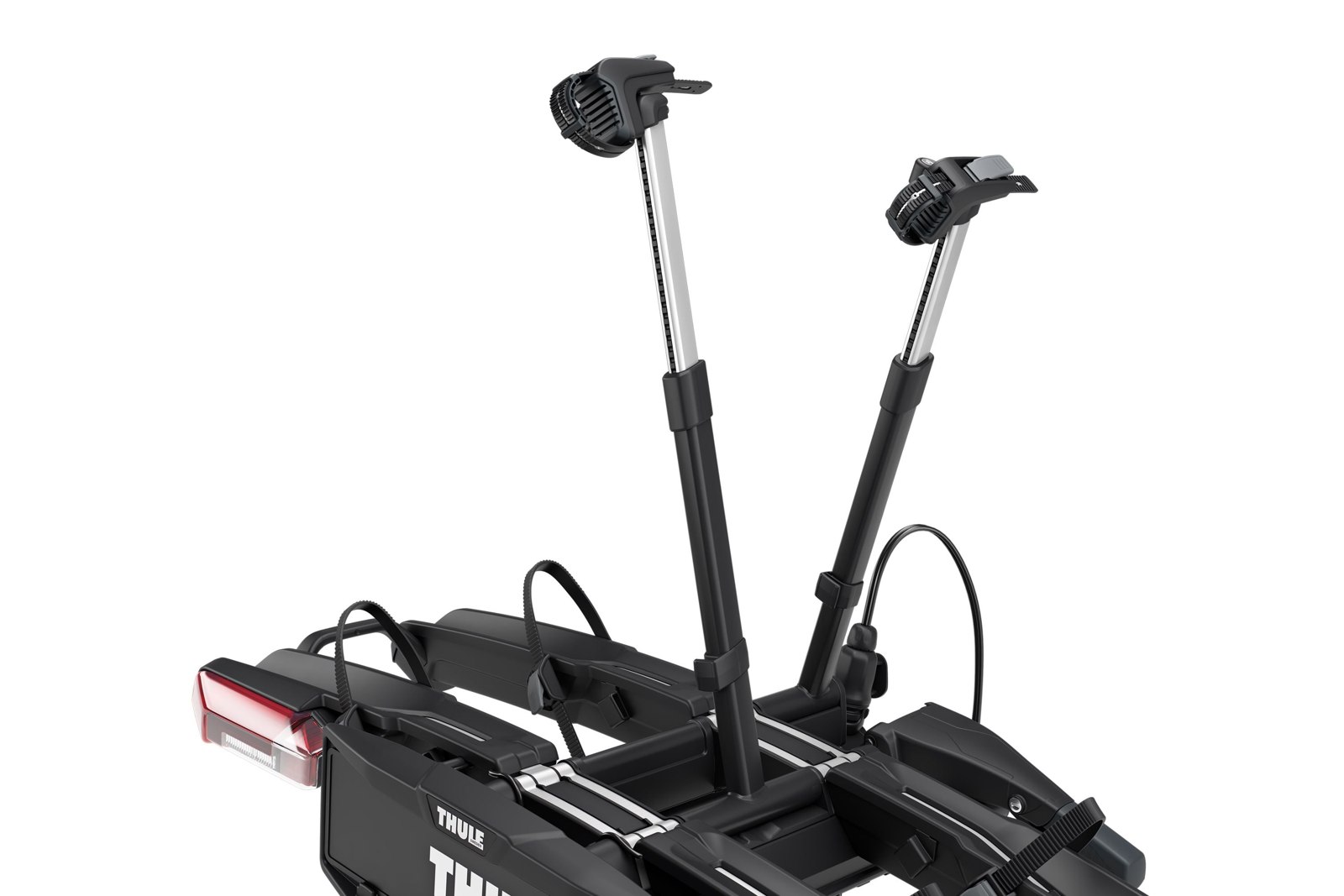
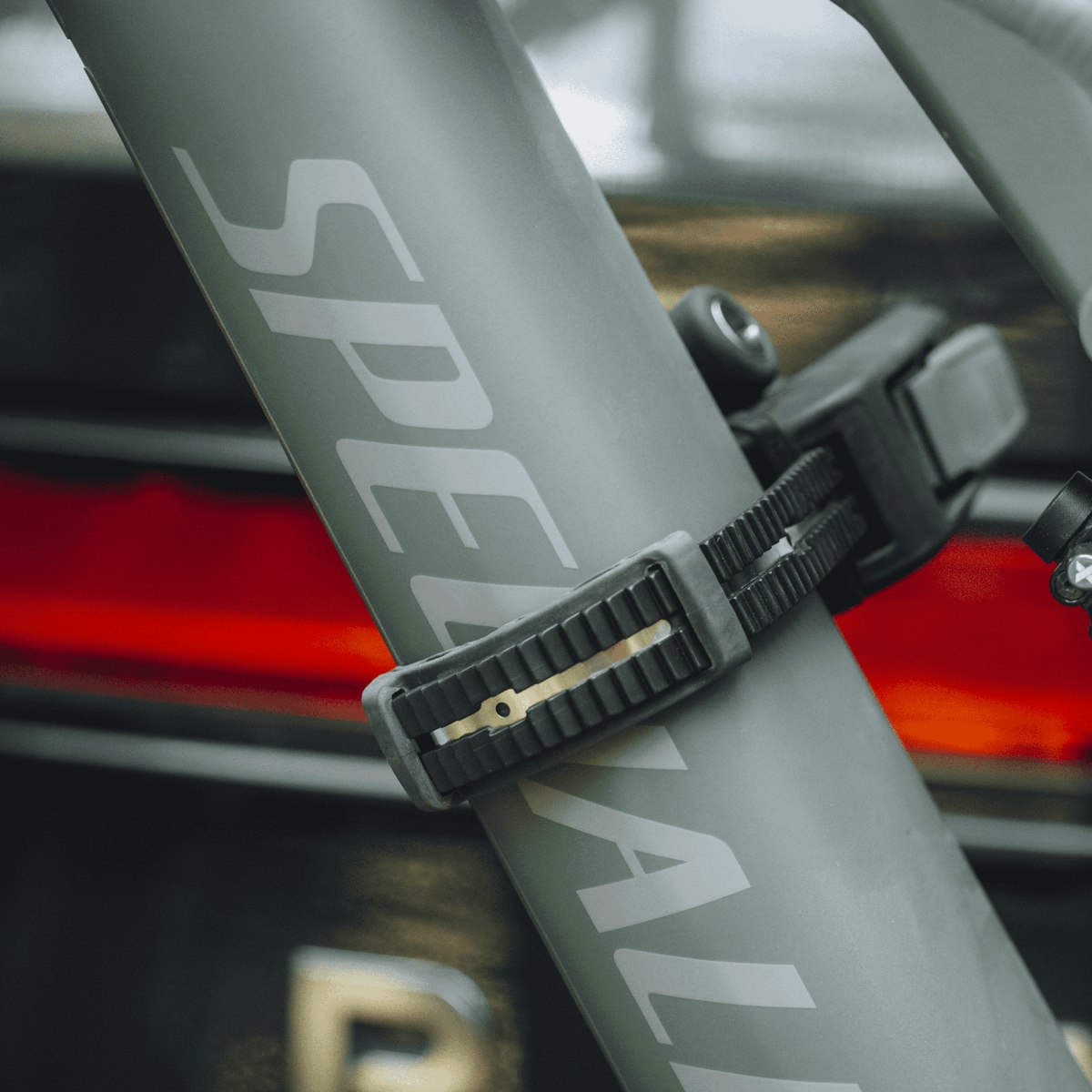
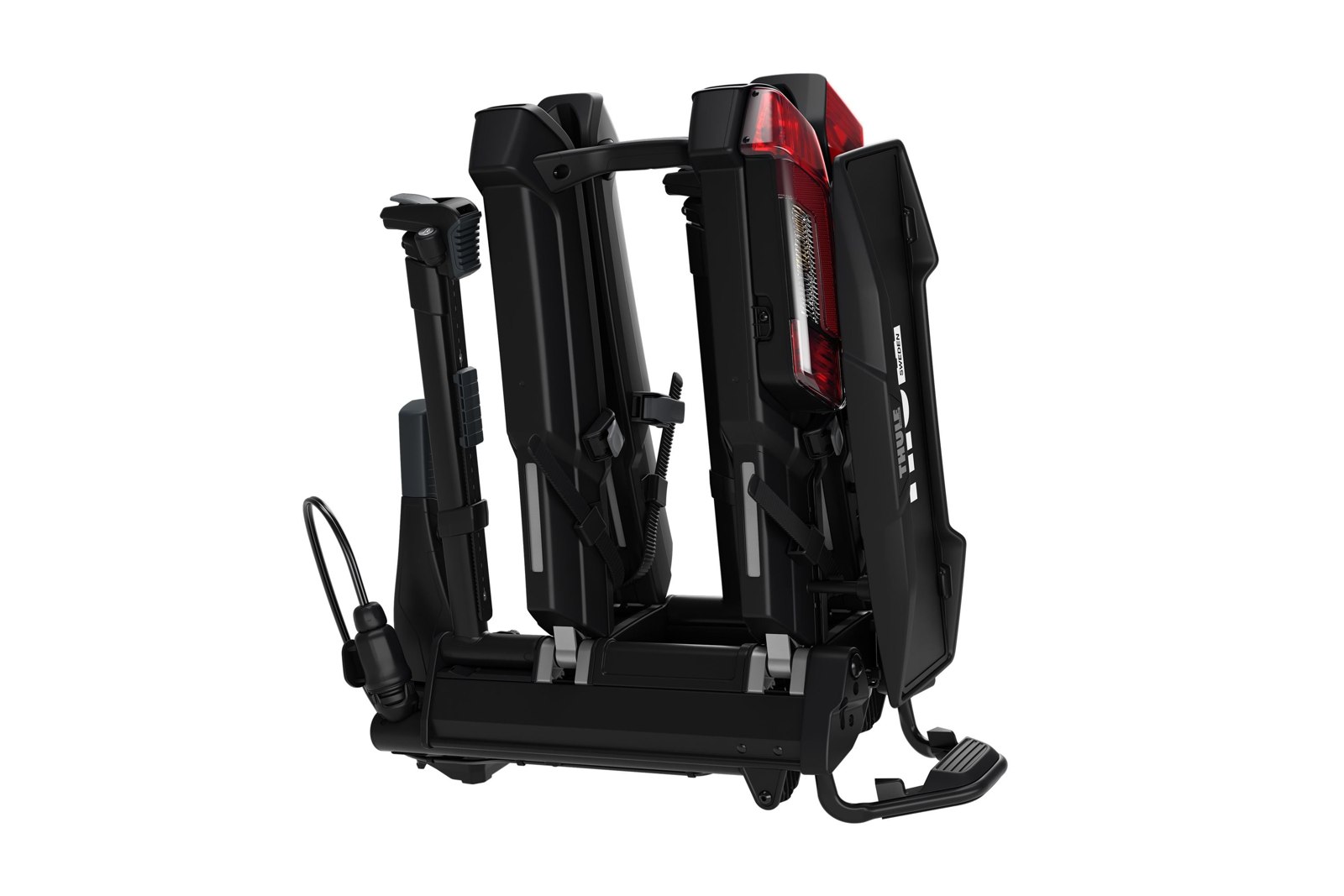
Epos uses telescopic arms with pivoting heads and straps, with options for fastening to the frame or the rear wheel according to the supported configuration. The official description shows the system. That flexibility helps find a position, but does not make every tube or accessory a suitable attachment area.
Test-fit your bikes and also consult their manufacturers' instructions, especially for carbon frames or unusual shapes. Check that straps do not press on wiring, controls, brake hoses or moving parts. If the intended point does not allow correct closure, do not compensate for poor positioning with more force.
Photographing your approved setup can help you repeat it as a reminder of the procedure learned. It does not replace checking every installation. If the second bike changes, reassess the entire layout: another handlebar, pedal or saddle can occupy previously free space. Assess compatibility with both bikes together.
Wheelbase and tires: measure more than diameter
The 978100 specification lists wheelbases up to 1,350 mm and 25 cm between bikes. Sections also differ: features mention tires up to 3.2 inches, while the technical table states 3 inches with standard straps. For a tire near that limit, explicitly confirm the combination before buying.
Advertisement / sponsored link
Do not confuse a 29-inch wheel with bike wheelbase. Two eMTBs sharing wheel diameter can have different lengths. Bring the actual measurement to the shop and check how the wheels sit in the trays. Secure them as the manual requires, not by relying on a strap barely reaching.
Also check interference between both bikes. Alternate positions only as permitted and inspect close points during a stationary test. Do not lower pressures or remove structural parts to force compatibility the manufacturer does not allow. If a specific adaptation is needed, identify its reference and approved use before including it.
Lighting and signage in Spain
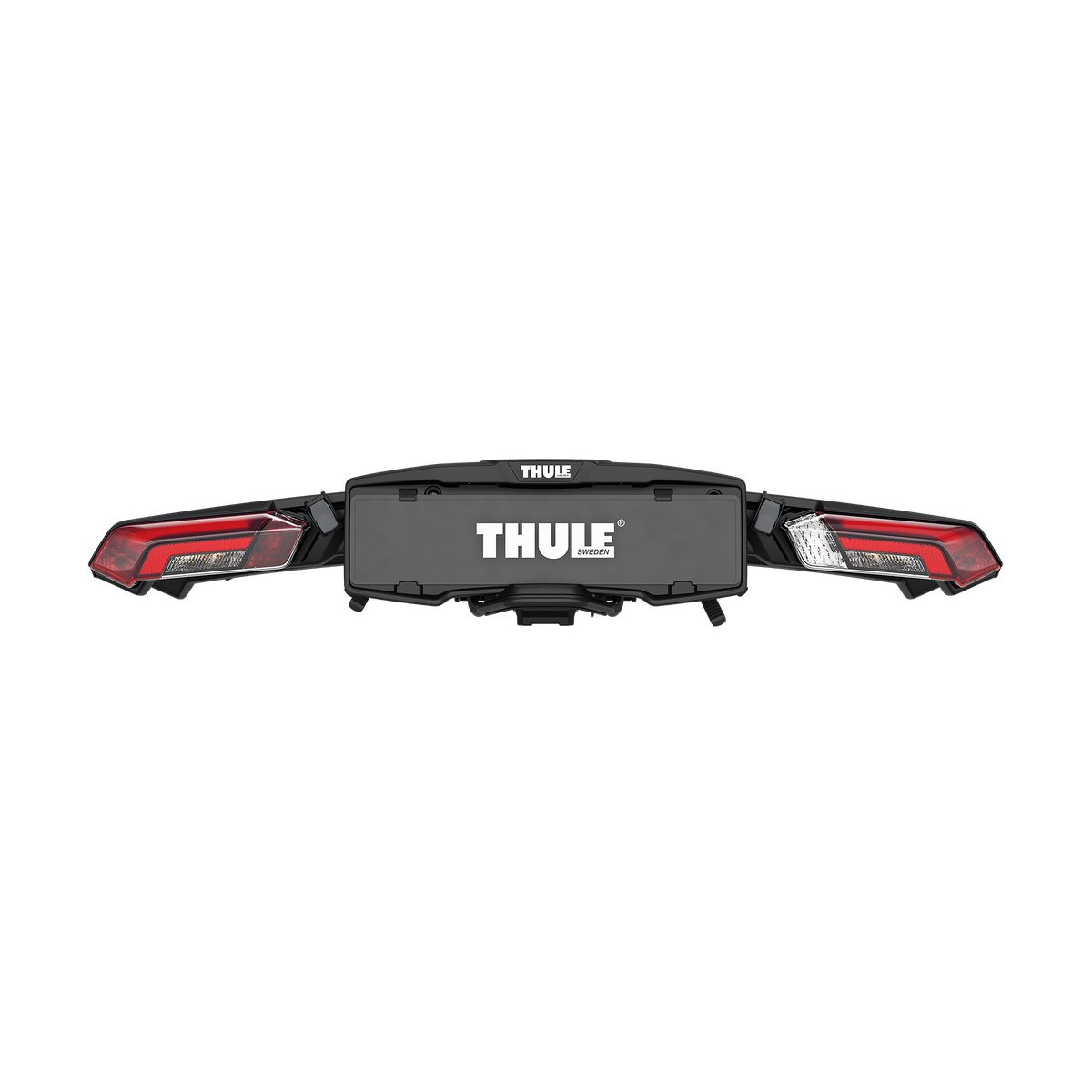
The European model examined uses a 13-pin connector. Before the first trip, check the lights with another person and inspect the vehicle installation if a function fails. Do not automatically blame the rack: socket, adapter and installation need checking together.
The DGT notes that the number plate and lights must remain visible, and requires a V-20 panel to mark loads projecting behind the vehicle. Its explanation of loads allows indivisible loads to project by up to 15% of a passenger car's length and distinguishes between one or two panels according to the width occupied.
Check the dimensions and final arrangement on your car; buying a rack with lights does not automatically resolve all marking requirements. If travelling outside Spain, check destination and transit-country requirements. Prepare the number plate, panels and fixings before departure day, without obscuring lights or interfering with bikes or the rack mechanism.
Advertisement / sponsored link
Test convenience when loading and unloading
The best rack for your situation is one you can use consistently. Before buying, try fitting the rack and loading a bike. These are different tasks: lifting a wheel onto a tray may be easy while bringing the rack to the towball is awkward.
If you need help, a compatible ramp or another approved solution, include it in your space and budget from the start. Try unloading too. After several hours of riding, you may be tired and the bike dirty; the manoeuvre should remain controllable without improvised supports.
Organise the sequence: clear the area, prepare the rack according to its instructions and have keys and straps ready. Avoid leaving a bike unsecured while searching the boot for a part. The shop demonstration should let you practise, not just watch an experienced person finish quickly. Being able to repeat it yourself is a real part of compatibility.
Tilting, garage space and storage
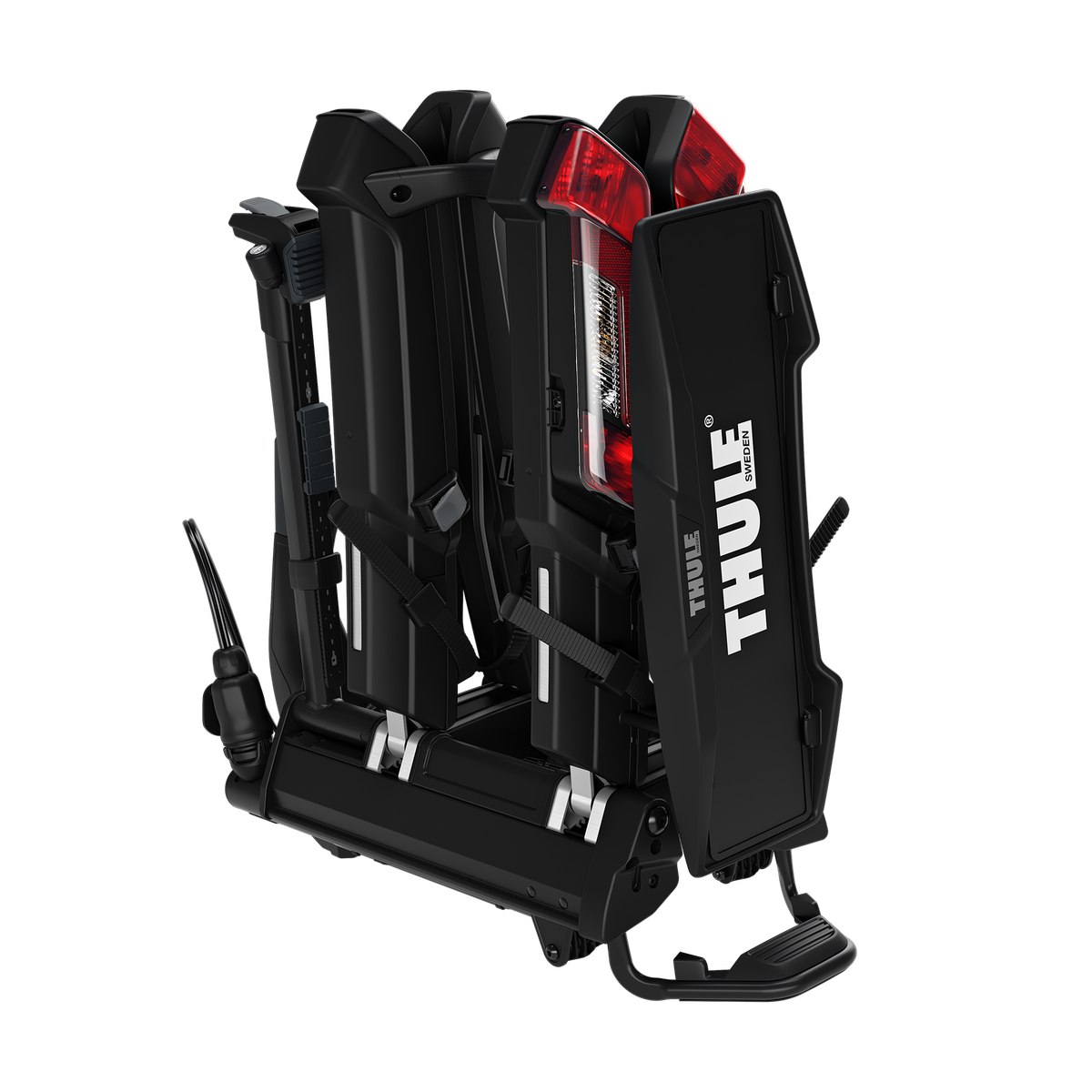
Thule advertises folding and tilting for boot access. Actual opening depends on the vehicle and loaded bikes. Before assuming it works, test slowly and check clearance through the tailgate's entire movement, without forcing it against the setup.
Consider what you need during a stop: water, warm clothing, tools or luggage. Keeping these accessible can avoid unnecessary manoeuvres. Do not open or tilt the system with someone in a trapping zone, and always follow the manual's procedure to return it to its travel position.
Check that rack storage is stable, dry and accessible. Folded volume tells only part of the story: you also need to reach it, remove it without hitting objects and carry it to the car. Measure the available shelf or corner before buying. A cover may help keep things tidy, but cannot fix insufficient space or a location awkward for its weight.
Three spaces do not mean three 30 kg eMTBs
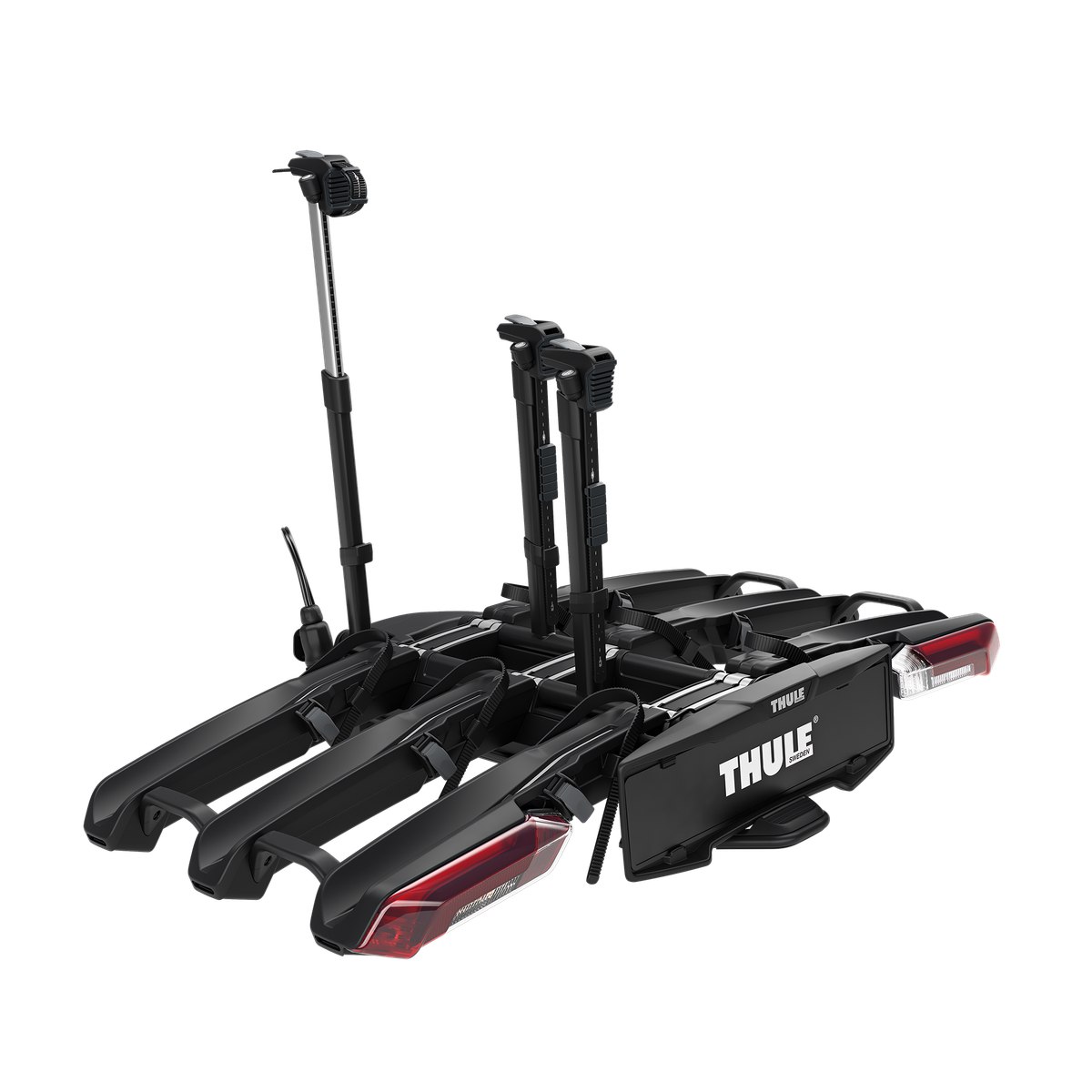
The three-bike Epos, reference 979100, also lists 60 kg total and 30 kg per bike, but weighs 22.7 kg. Three spaces do not raise total capacity to 90 kg. This section's photograph shows that variant, not the 978100 used in earlier calculations.
Example: three 20 kg bikes total 60 kg; with this rack, the setup reaches 82.7 kg before accessories. Two 26 kg bikes would give 74.7 kg. With an applicable vertical limit of 75 kg, the latter calculation leaves only 0.3 kg. Check actual weights, accessories and all other limits before considering it valid.
If you always carry two heavy eMTBs, I would not treat a third space as an automatic upgrade. If you alternate eBikes with a child's or conventional bike, it may make sense, but calculate each combination separately. Required capacity should reflect your usual passengers and bikes, not the maximum number of trays available.
Make checking a short routine
The Thule instructions require checking attachments and parts and replacing damaged or worn items. Learn your specific model's procedure and keep its instructions. Inspection is not simply tugging a bike and assuming everything else is correct.
I suggest inspecting in the same order every time: vehicle connection, rack structure, each bike's attachments and electrical components. This reduces missed checks after an interruption. Then check for loose keys, tools or straps that might be lost or cause interference.
Advertisement / sponsored link
At stops, look for changes and perform the manufacturer's specified checks. If there is abnormal movement or a damaged part, stop somewhere safe and resolve the cause before continuing. Do not improvise a structural repair to finish the trip. Keeping spare-part references and dealer details makes obtaining the right part easier when needed.
Questions before finalising the purchase
Can I bring two 30 kg bikes?
The two-bike Epos total limit permits that sum, but the rack adds its own weight and vehicle and towbar limits must be respected. Published figures give 77.3 kg before accessories. The answer depends on the complete combination.
Does removing the battery always solve the excess?
No. It must be removable using an approved procedure, and the resulting setup must be reweighed. The removed battery also needs proper transport. Some eMTB batteries are intended for removal only during workshop servicing.
What would you take to the store to check?
Car and towbar details, both bikes' dimensions and weights, and a description of where you will store the rack. Wherever possible, I would test-fit the actual bikes. This is the most direct check of attachment, interference and handling.
The Epos is worth assessing for its attachment system and practical layout, but choosing starts with your own figures. Once load, dimensions and manoeuvres work, you can compare price and accessories on a useful basis.
Sources and documentation
Information checked on September 8, 2026. Photographs belong to the identified manufacturers; specifications and availability may vary by market. Editorial analysis, not our own ride test.
Have you used this bike, motor or component?
Join eRIDERSeMTB on Telegram to discuss real experiences with other riders: Bosch, Avinox, Shimano, deals, faults and buying decisions. The community currently speaks Spanish.
Join TelegramAdvertisement / sponsored link
Advertisement / sponsored link
Advertisement / sponsored link