Strive:ON CF 8 vs CF 9: What the Extra €1,000 Buys
Technical guide · eMTB PRO
€3,999 versus €4,999: the same battery capacity and geometry, but different components. What the CF 9 adds and what to confirm before buying.
The difference is €1,000, not a different battery
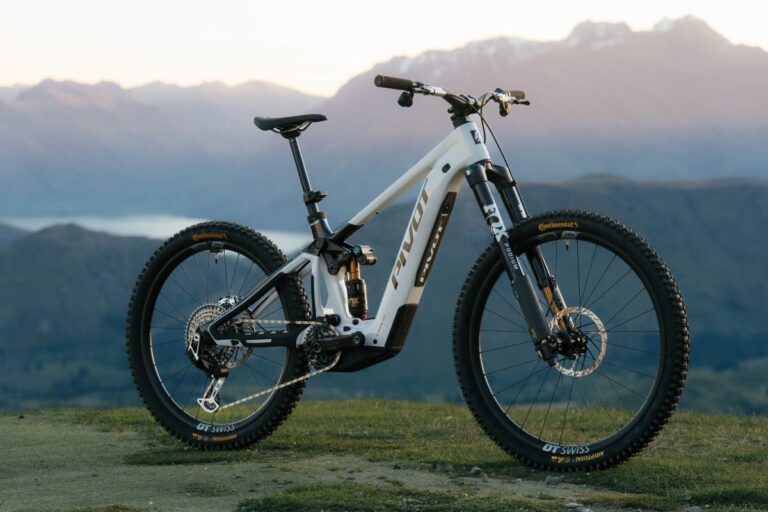
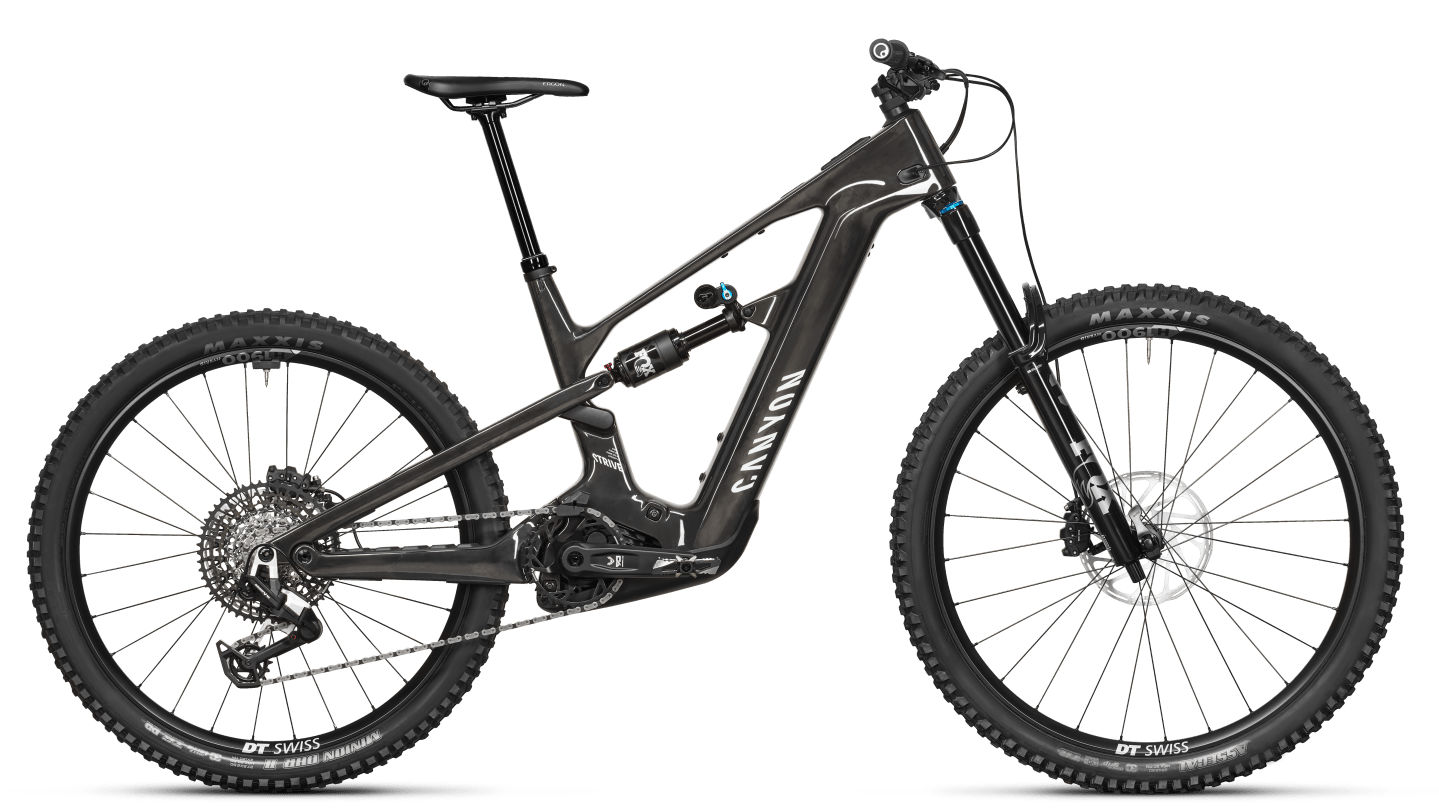
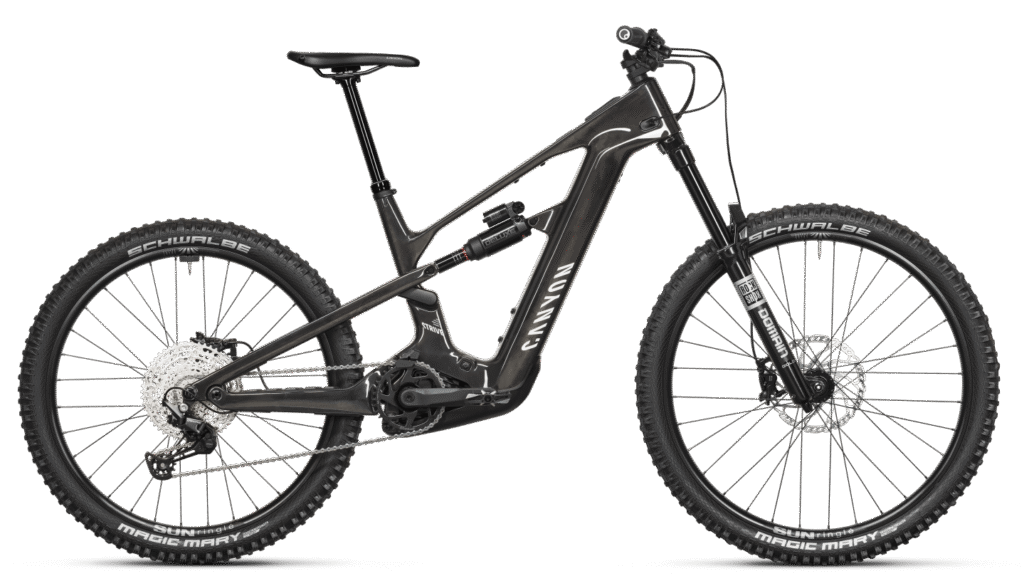
Cover photo: Canyon, Strive:ON CF 9 Raw Stealth.
The Strive:ON CF 8 costs €3,999 and the CF 9 €4,999 on the Spanish product pages consulted on 2 November 2026. The useful question is not which has more expensive parts, but whether you will make use of what changes. On paper, they share battery capacity, travel, geometry and claimed complete-bike weight. The premium goes towards suspension, brakes, drivetrain, wheels and tyres.
Our starting point: the CF 8 deserves to be the value benchmark if you want a fully equipped e-enduro bike and can keep its stock build. The CF 9 makes more sense if you want its FOX, Maven and Eagle 90 package from the outset. We would not choose it simply expecting more range, more motor output or a weight saving: the specifications do not support those three expectations.
This comparison covers SKUs 4295 and 4294, both in Raw Stealth. We do not attribute the higher-spec CFR's build to them or carry over a score from an earlier ranking. This is an editorial guide based on documentation, not our own ride test or a launch happening today. Canyon introduced this evolution of the platform in May.
Advertised price, displayed total and recent lowest price
To compare actual costs, you need to separate the bike from delivery. Both pages add €99.90 for packaging and shipping and state that VAT is included. We have not completed a purchase or entered a postcode: these are product-page totals, not final delivery quotes for every address.
Spain, EUR; checked on 2 November 2026
- Bike
- CF 8: €3,999
CF 9: €4,999 - Struck-through reference price
- CF 8: €4,999
CF 9: €6,499 - Displayed 30-day low
- CF 8: €3,499
CF 9: €4,999 - Displayed packaging and shipping
- CF 8: €99.90
CF 9: €99.90 - Displayed total including VAT
- CF 8: €4,098.90
CF 9: €5,098.90
The extra €1,000 is approximately 25% of the CF 8's price excluding delivery. There is another important point: this CF 8 is €500 above the recent low shown by Canyon. The discount against the struck-through reference price does not establish that this is its best deal of the past month.
If your total budget is €5,000, the CF 9 already exceeds it with the shipping charge shown. I would not address that by switching to a monthly finance figure: that changes the payment schedule, not the full cost of the bike. Check the outright purchase price of your configuration.
What they share limits what the upgrade buys you
Both product pages list 170 mm of travel up front, 160 mm at the rear, a 29-inch front wheel and 27.5-inch rear, and a 750 Wh Bosch PowerTube battery. Both also feature K.I.S. 2.0 and claim 24.8 kg for the standard configuration in size M. That is Canyon's claimed weight, not our own measurement, and it does not support a promise that the CF 9 is lighter.
The same nominal capacity does not guarantee identical range either. Tyres, pressures, terrain, temperature, assistance and riding style can affect consumption. The buying logic is simpler: paying for the CF 9 does not add any Wh to the battery listed for these two configurations. If your problem is a route that demands more energy, that premium does not solve it through extra capacity.
K.I.S. applies a centring force to the steering through internal springs, according to Canyon. It is not electrically assisted steering and does not replace your hands, technique or line choice. The brand claims stability benefits; we do not turn those claims into a measured result here. Since both bikes include it, it is not in itself a deciding factor between the CF 8 and CF 9.
Suspension: a genuine difference in specification
The CF 8 pairs a RockShox Domain Gold R with a Super Deluxe. The CF 9 has a FOX 38 Performance Elite GRIP X2, and its detailed component list identifies a Float X2 Performance shock. Both forks are listed with 170 mm of travel. Reading FOX or RockShox is not enough: the specific model, its adjustments and the setup you can use are what matter.
The CF 9's package makes sense for riders who already know which settings they want to explore and want that equipment from delivery. If you cannot yet identify what your suspension lacks, setting money aside for an initial setup and servicing may be more useful than buying more adjustment without learning to use it. That is editorial judgement, not a measurement of times or grip between the two bikes.
There is a discrepancy we will not gloss over: the CF 9's marketing overview says Float X, while the component list says Float X2 Performance. Before paying, ask Canyon to confirm which shock your bike includes. We would not treat the name in an overview or a photograph as a guarantee of the equipment that will arrive.
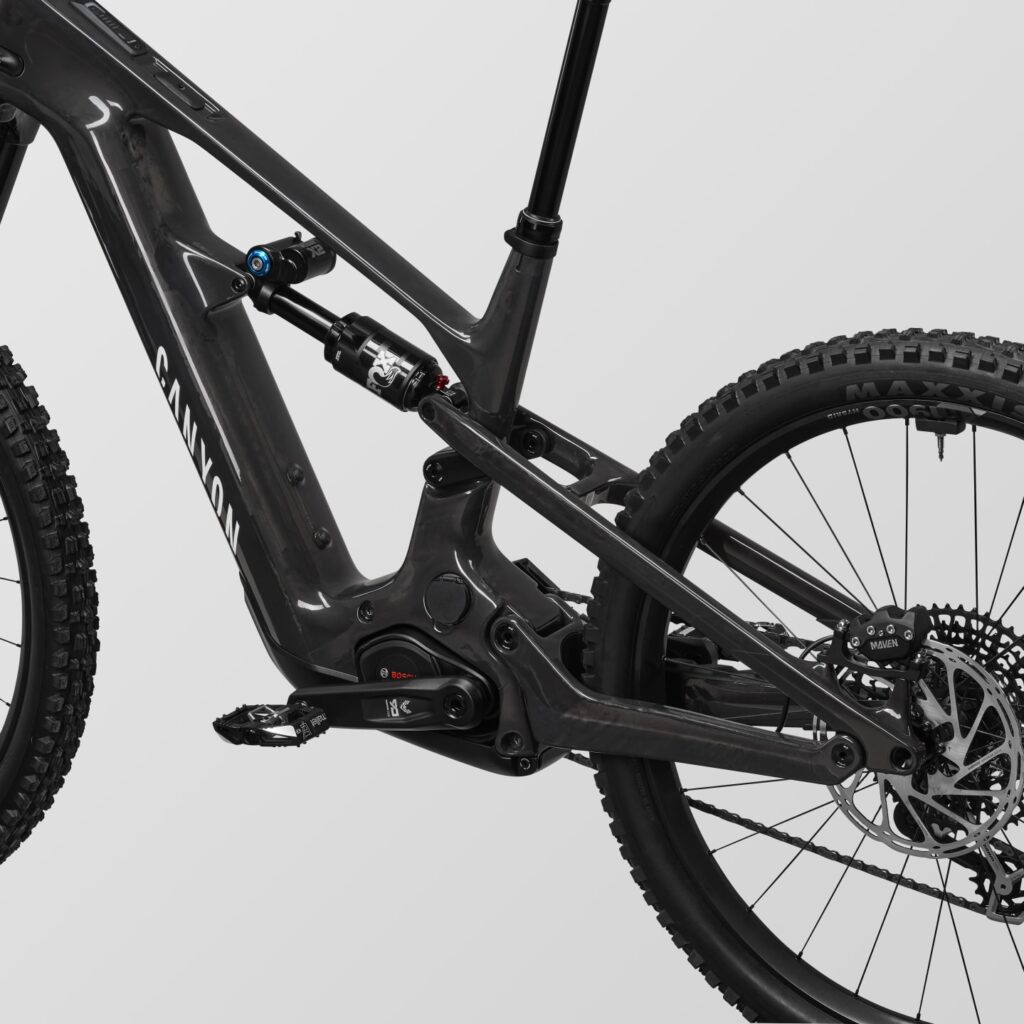
Which adjustments are you paying for? RockShox documents external rebound adjustment for the Domain Gold R . FOX describes separate high- and low-speed compression and rebound adjustment for GRIP X2 in the 38 . Speed here means suspension movement, not how fast the bike is travelling. Compression adjustment lets you address slower weight inputs and faster impacts separately; it does not add travel to the bike.
That gives the CF 9 a functional purpose if you repeat descents, record how the bike feels and want to refine those responses using external controls. The trade-off is more variables: unsuitable settings can undermine the setup. If you want to set pressure and rebound and ride without that process, the CF 8's simplicity can be a practical advantage. We have not measured which descends faster, and we do not attribute the fork's adjustments to the rear shock.
Maven and Eagle 90 versus SLX and Deore
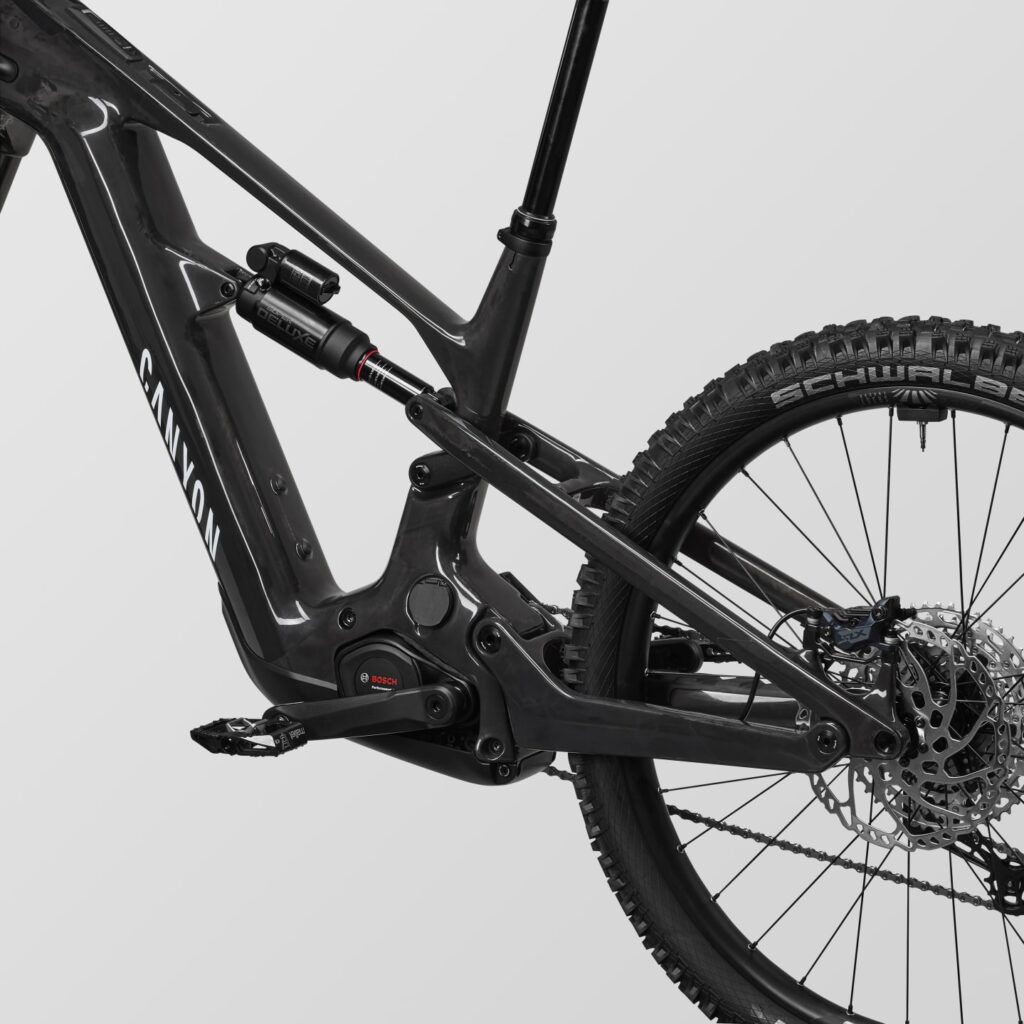
The CF 8 offers four-piston Shimano SLX M7120 callipers, RT66 rotors measuring 203 mm and a twelve-speed Deore M6100 drivetrain with a 10-51 cassette. This is an identifiable build that lets you plan servicing and spares without having to guess which drivetrain family it uses.
The CF 9 lists SRAM Maven brakes and 200 mm Centerline rotors. The product page does not specify a Maven variant: we would not describe them as Ultimate or Silver without confirmation. Nor does rotor diameter alone establish which of two systems is more powerful. Before changing anything, consider compatibility, condition, setup, suitable pads and the rider's adaptation to the brakes.
The CF 9 uses mechanical Eagle 90 Transmission with an XS-1275 cassette in 10-52. Choosing this version does not buy you electronic AXS shifting. If that system appeals, read our dedicated guide to Eagle 90 on eMTBs and check how to identify its consumable parts.
The financial question is whether you would keep SLX and Deore. If so, the CF 8 leaves a substantial amount in your pocket. If you plan to replace almost everything immediately with the CF 9's parts, compare the full cost and installation first; buying the cheaper base bike to strip it down is not always a saving.
Another practical distinction is derailleur repair. The official Eagle Transmission service manual identifies inner links, the skid plate and the cage assembly as replaceable parts on Eagle 90, with specific procedures. If you want to keep the derailleur and repair subassemblies after wear or damage, that architecture is a reason to consider the CF 9. We are not saying Deore is unrepairable or that a warranty covers every impact.
The trade-off is identifying and obtaining compatible T-Type spares and following the correct procedure. We have not priced those repairs: rebuildable does not mean free or automatically cheaper. If you prefer keeping a Deore system you already know and your workshop supports, the CF 8 still makes sense. Both are mechanical; you do not need to pay for the CF 9 simply to avoid a derailleur battery.
Advertisement / sponsored link
Wheels and tyres: compare packages, not prestige
Canyon lists Sunringle 309/307 Enduro Comp wheels on the CF 8 and DT Swiss H1900 on the CF 9. The listed tyres differ too: Magic Mary Gravity on the former, Assegai and Minion DHR II on the latter. We do not attribute compounds, casings or weights that are not identified for that exact configuration.
These differences may affect replacement costs and how you adapt the bike to your terrain, but we have not compared their grip or durability. Look at which combination you would keep, not just which logo you prefer. Swapping to tyres unsuited to your routes can undo part of either bike's financial advantage.
The CF 9's list includes a wheel-material description and a rear axle specification that conflict with other fields on the same product page. There is no basis here for buying it expecting a carbon wheelset. Confirm the model, material and axle standard; our guide to the DT Swiss Hybrid ranges helps you frame those questions, but does not replace confirmation of the build being sold.
A CX sticker does not establish 120 Nm
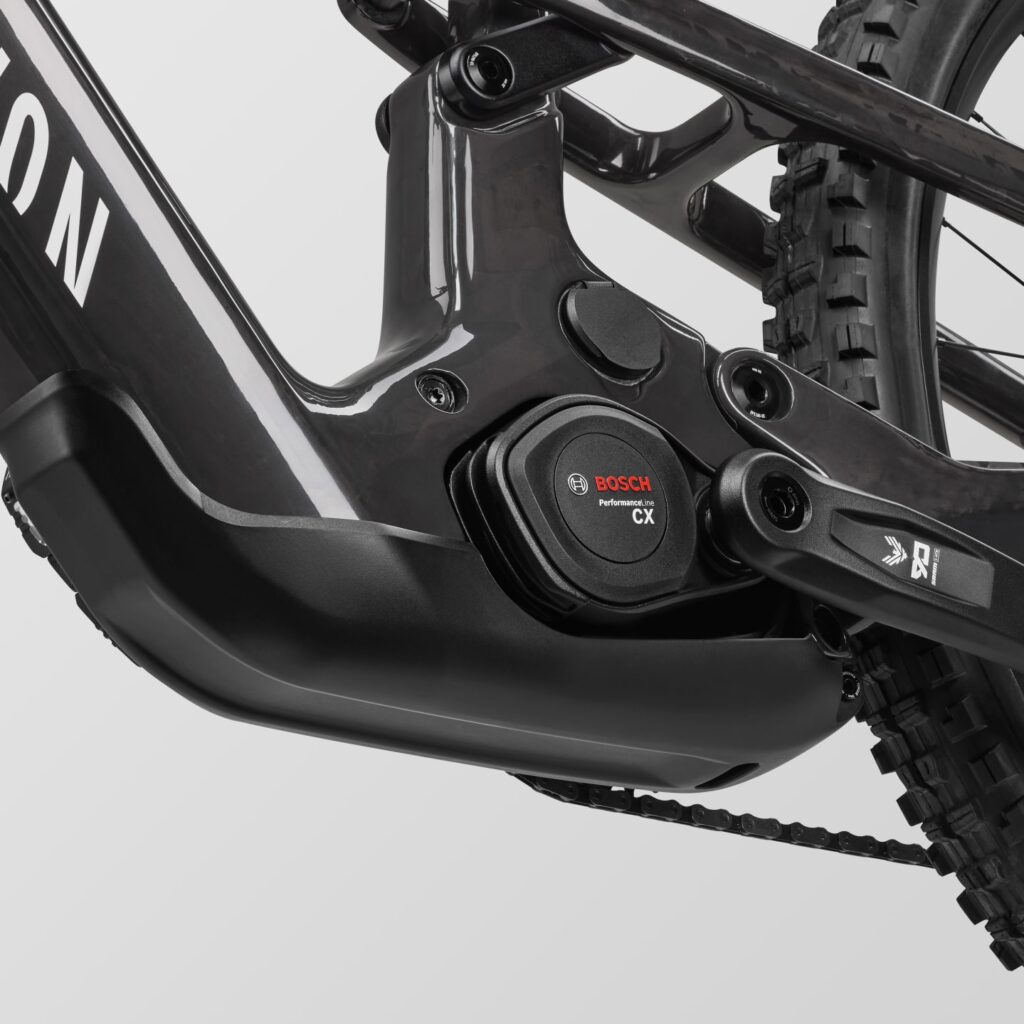
Both component lists identify Bosch Performance Line CX, with 85 Nm and 120 Nm available through Performance Upgrade according to Canyon. Its marketing claims up to 750 W. What we have not established is each bike's BDU identifier or which firmware and limits are enabled on delivery. We do not assign a generation simply by reading the CX name or looking at the housing.
The official Bosch compatibility table matters: it distinguishes the CX BDU384Y, which can reach 120 Nm and 750 W with Upgrade 2.0, from the CX BDU374Y, limited to 85 Nm and 600 W. An update that increases the assistance percentage is not the same as increasing every motor's torque.
Ask for the BDU identifier of your chosen bike and confirm which upgrade it supports and the configured limit. That specific check is better than assuming a universal improvement. Nor would we turn a peak figure into a claim of constant range or continuous power. And, since the bikes share the advertised product family, the motor is not an established advantage of the CF 9 over the CF 8.
Sizing can matter more than the fork
The geometry tables match. Listed reach figures for S, M, L and XL are 450, 475, 500 and 525 mm; the head angle is 63.5 degrees and the chainstays measure 445 mm. There is a 25 mm reach difference between consecutive sizes: that is not a detail a more expensive part will fix.
We do not recommend a size based solely on height or the size label on your previous bike. Cross-check your body measurements, riding position, overall bike length and usable dropper travel against Canyon's calculator and geometry. Consider trying a size if you can: on a bike intended for demanding descents, choosing the higher-spec version will not compensate for a poor fit.
The product pages show sizes in the selector and member-access messages. That does not establish immediate availability. During our checks, we also found differing CF 9 stock signals between metadata readings. We are not publishing a delivery promise by size: select the configuration and check the visible conditions before deciding.
Practical checks I would make on delivery
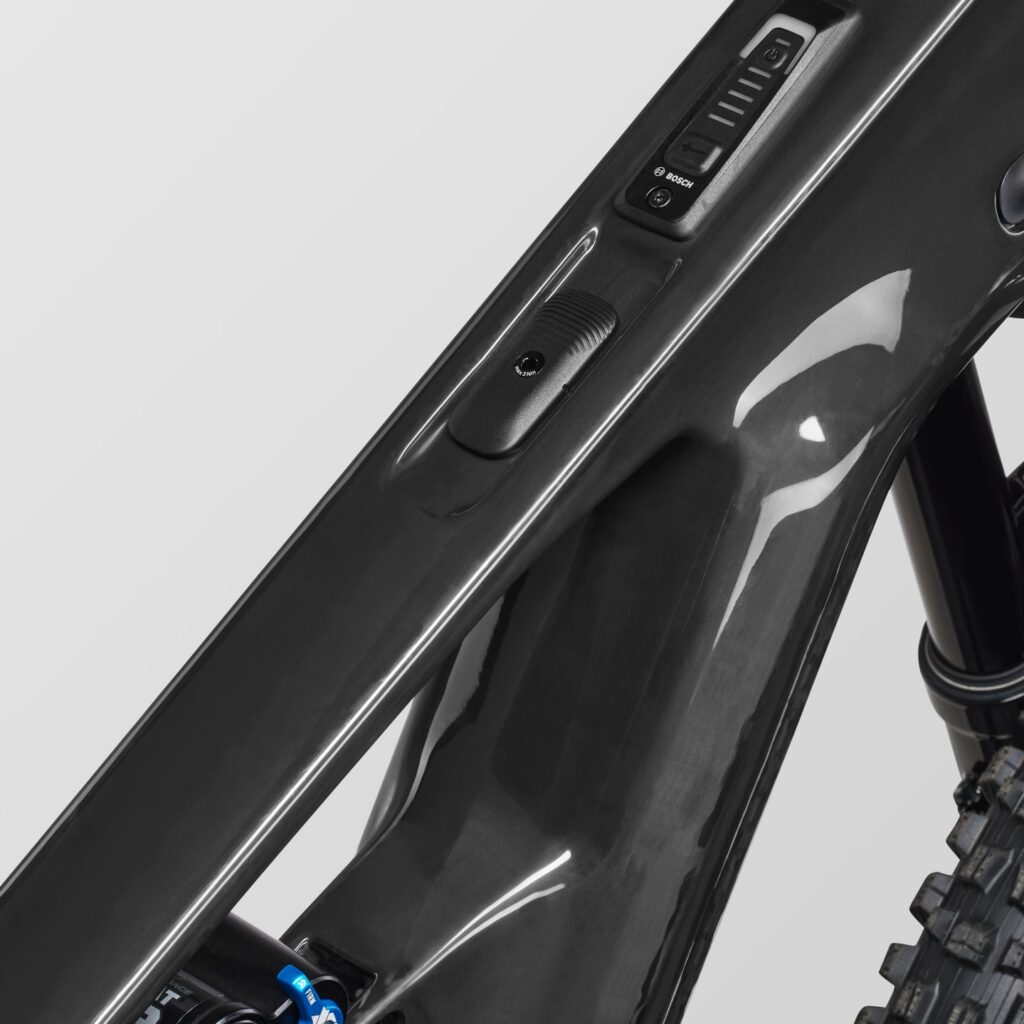
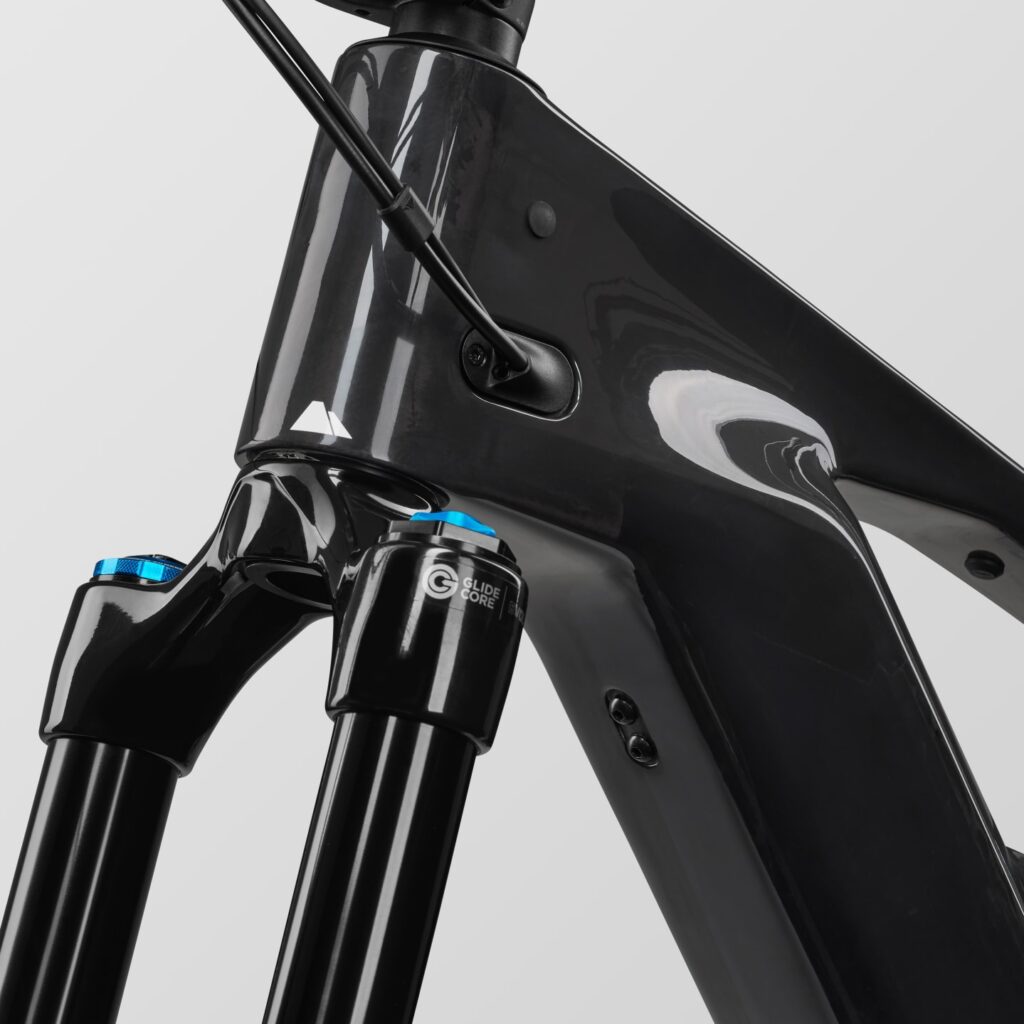
Cable routing through the frame, the charging-port cover and the underside protector are among the improvements Canyon advertises for this platform. The photo shows the cable entry; it does not establish durability, measured watertightness or that a particular maintenance job will be quicker. We have not dismantled either of these bikes.
Before your first ride, I would check brake setup, appropriate pressures, suspension, the condition of the fasteners and motor documentation, following the manufacturer's procedure. If you choose a delivery or assembly service, confirm what it includes and its cost: we do not add it to the bike's price free of charge simply because it is advertised on a page.
For the frame, the marketing figure of 2.45 kg and the 2,970 g in the component list have no documented explanation here of what each includes. That is why we use the claimed complete-bike weight, clearly attributed, rather than calculating a weight saving. Apply the same discipline to the invoice: get the exact product reference, components and terms in writing.
What I would choose for your needs, not the catalogue
CF 8: it would be my first choice for value if the size fits, I am happy with its build and I prefer to set aside the €1,000 for equipment, setup and servicing. Its current price is not the advertised recent low; you can consider waiting without mistaking a struck-through discount for a once-only opportunity.
CF 9: I would choose it if I specifically wanted its suspension, Eagle 90 drivetrain, brakes and wheels, after clarifying the conflicting fields. The difference can make sense as a component package. I would not justify it by saying it offers more battery capacity, weighs less according to the product pages or delivers more torque than the CF 8.
Which should you buy with a total budget of €5,000?
The CF 8 comes in below that with the shipping shown; the CF 9 totals €5,098.90. Confirm the final total, size and any added services. We do not count finance as a discount.
Does moving up to the CF 9 guarantee better performance?
We have not measured it. We identify equipment differences and the preferences that might justify paying for them, not an improvement in times, grip or range demonstrated by eMTB PRO.
Are these prices or terms for the United States?
No. These are Spanish-market product pages, in EUR and subject to their published terms. The English version retains that context and does not confirm sales, taxes or delivery in the US.
The photographs are Canyon's, with a cover-photo reference and credited captions; the visible logos are physically present on the products. This article does not imply sponsorship or a loaned or tested bike. Our contribution is to clarify the decision and highlight what still needs confirming before you commit your budget.
Sources and documentation
Data checked on 2 November 2026. Editorial guide based on official documentation, not our own ride test. Equipment and availability may vary by market.
- Canyon Spain: Strive:ON CF 8, SKU 4295
- Canyon Spain: Strive:ON CF 9, SKU 4294
- Bosch: Performance Upgrade and drive-unit compatibility
- Canyon Newsroom: platform introduction, 1 May 2026
- FOX: 38 owner manual and GRIP X2 adjustments
- RockShox: Domain Gold R FS-DOMN-GR-C1
- SRAM: Eagle Transmission service manual
Have you used this bike, motor or component?
Join eRIDERSeMTB on Telegram to discuss real experiences with other riders: Bosch, Avinox, Shimano, deals, faults and buying decisions. The community currently speaks Spanish.
Join Telegram